Shaken, but emotionally under control, Bryan Mills (played by Liam Neeson) picks up the phone and talks to his daughter’s captor.
“I don’t know who you are. I don’t know what you want. If you are looking for ransom I can tell you I don’t have money, but what I do have are a very particular set of skills. Skills I have acquired over a very long career.” – Liam Neeson, Taken
Like Liam Neeson’s character, I don’t have all the answers. It’s actually very cathartic to admit. Let’s say it together. Ready?
“I don’t have all the answers.”
In creative or innovative work, we sometimes feel like we should come up with new and interesting solutions on the spot. And if we can’t, no one is harder on us than ourselves. But we don’t have all the answers, nor should we.
We should have are all the questions.
Ok, maybe not ALL the questions, but a pretty good list and the skill to keep asking. At least we can channel our inner child and ask “Why?” over and over. Seriously, that’s a proven tactic. So if asking questions is the fast track to empathy, why do we feel compelled to know the answer ahead of time?
I don’t know.

Anticlimactic I know, but it’s true. I’ve asked myself many times, so I’m beginning to know why for me. But this is a personal quest. A side quest to be sure, but a personal one.
Let me give you some starter questions:
- Do I feel like I need to prove my innovative spirit or creativity by readily spouting out solutions?
- Do I feel others are expecting immediate and ground-breaking ideas?
- Do I feel like my value drops if I have to “figure it out” in the conversation?
- Is it related to stress, anxiety, impostor syndrome, and my fight or flight reflex?
Sherlock Mode
One of my favorite shows is Sherlock (the one with Benedict Cumberbatch). Sherlock Holmes is a character that seems to have the answer to everything, even to problems we didn’t know existed. But the show does a masterful job of showing how Sherlock’s mind (albeit fictional) works.
Time slows. We enter Sherlock’s mind. We see him call out the wet spot on the sleeve of a woman’s jacket. He internally questions how her sleeve got wet.
I try to engage my own Sherlock mode; slow it down, ask the questions.
Silence is Golden
We don’t have to shout out answers immediately. Amazing things happen when you listen and offer your ideas last. Check out this video where Simon Sinek talks about being the last to speak.
It doesn’t make us less valuable to say “I don’t know, but I want to. Help me understand.” Asking questions improves our learning. That’s why schools are promoting critical thinking and project-based learning (which involves lots of questions).
So we need to take a cue from Liam Neeson and create our own Taken-inspired, problem-facing monolog.
“I don’t know what your problem is. I don’t know what your jobs to be done are. If you are looking for a solution I can tell you I don’t have one… YET, but what I do have are a very particular set of skills. Skills I have acquired over a very amazing career. Skills that make me a nightmare for problems like this. If you will answer my questions, that’ll be the start of it. I will look everywhere for insight, I will pursue each hypothesis, I will create tailor-made solutions for you, and I will go forth and be awesome.”
 This is a place where mankind has sanitized, homogenized, and developed using a rigid and typically unforgiving material; concrete. A downfall of concrete’s hard-line take on the world is that sometimes cracks form. Cracks that let the organic spurt through. Dirt and rain make their way down, plants make their way up, and we’re left with this analogy. Creative ideas can grow in restrictive environments.
 rosebush growing into the neighbor’s yard. These restrictions come from your users (it needs to be mobile, it has to do [task] faster, etc). However if we don’t let solutions diverge from the root of the problem, we wont have a chance to converge them into the best bouquet of products possible.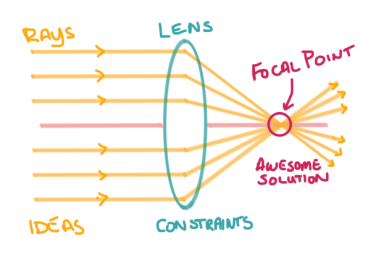
 I can’t imagine a less appealing career than being a video game villain. No matter how hard you try, or how many henchmen you hire, the hero is destined to win the game. Castles broken. Airships grounded. Treasure looted. So what does the video game villain do next? They build a different castle, marginally tougher, but still pretty much using the same stuff. Insanity? Maybe. But definitely on the way to a breakthrough innovation.
 , and in the end you have a better version of what you do. Fits in your existing business model.


 I’m in the middle lane of a three lane road, on the last leg of my school drop-off delivery. Just one of my kids left to go. A car in front of me has their right turn signal on. Flashing their intention to the world adjacent and slightly behind them. They kept going straight; no merging, no lane changing.
 In our everyday, there are hidden aspects of problems that we can’t really see. Thats why auto manufacturers added all those mirrors, cameras, and sensors. What do we do as innovators? We can’t walk through life with an array of mirrors strapped to us. No, this is when we use some lenses. Previously, we’ve talked on the surface level of lenses (
 Everyone has heard a tale or two of people with diverse, opposite appearances. The Frog Prince and the Beast can change form with true love, Dr. Jekyll and Mr. Hyde serve as faceted personalities of the same man, and Hulk smash when Dr. Banner gets mad. While the characters’ appearances serve as moral backgrounds for allegories and folk lore, there is a lesson to be learned here for innovators.
 Go Forth And Be Awesome