Once upon a time, there was a donkey. This donkey, with all other conditions being the same, would eat from the hay closest to him. Kind of an easy win strategy. Well one day the donkey was walking down the road and his hunger grew immensely. There was a bail of hay up ahead, and an equal sized bail of hay, the exact same distance behind him. With neither being closer, the donkey stood still, not choosing one nor the other until he died.
The end.
This heartwarming tale is called Buridan’s donkey and it is a paradox about free will. Often, we become the donkey. There are disruptive ideas out there to follow, but we sit in the middle, too afraid to give up one for the other.
Nassim Taleb, in his book Antifragile, says that “when some systems become stuck in a dangerous impasse, randomness and only randomness can unlock them and set them free.” The donkey just needs a little push; just one fly to land on its ear and nudge it towards one hay pile.
Organizations, teams, and people need that dose of random, unexpected, and different to get ideas moving.
These little nudges can feel scary, but there are ways to minimize the risk and fear. Start by breaking down the problem you want to solve into its core pieces; boil it down to its base essence. Then start looking for small things to move the needle. If you were to solve this problem, what’s the first thing you need to figure out? Find a way to prototype and test that thing. Prototyping is great for keeping cost low and risks at a minimum (especially when it is with paper).
“Prototyping is one of the most effective ways to both jump-start our thinking and to guide, inspire, and discipline an experimental approach.” – Peter Sims, Little Bets
Regularly we will need to unstick ourselves. Each idea we naturally think of is a byproduct of your point of view, past experiences, skill set, and what you had for lunch. That’s why I am going to give you a tool to help, a tool forged in process-driven chaos. It’s called…
Donkey Dice
The rules here are very simple. In fact, there’s only three:
- CARD: On a notecard, write down six lenses and number them.
- Things like “How would WordPress do it?”, “How would I never solve this?”, or use a random word. (Random words should be generated before each use of Donkey Dice.)
- ROLL: Roll 1 six-sided die and identify lens selected
- THINK: Generate ideas with lens
It’s simple, but effective. As you get good at Donkey Dice, expand your card up to 12 lenses and use two six-sided dice. You can unlock the extreme level and list 20 lenses and roll a twenty-sided die. Soon your donkey will be making his way towards relief, instead of stuck in the muck of status quo.
“I wondered about the explorers who’d sailed their ships to the end of the world. How terrified they must have been when they risked falling over the edge; how amazed to discover, instead, places they had seen only in their dreams.” -Jodi Picoult, Handle With Care
 Curves are the enemy of fast moving trains. Just ask Denzel Washington and Chris Pine in Unstoppable. Nearly 30 years before the movie, The British Rail Research Team unveiled the
  In Episode 20 of Gimlet Media’s podcast, StartUp, Lisa Chow investigates what happens when a lean, “let’s all try to do new things” startup shifts into the established, “wait we have an HR department now?” organization. It’s a brilliant take on the need for process and the translation of vision from one strategy to the next.
  I’m in the middle lane of a three lane road, on the last leg of my school drop-off delivery. Just one of my kids left to go. A car in front of me has their right turn signal on. Flashing their intention to the world adjacent and slightly behind them. They kept going straight; no merging, no lane changing.
 Setting a goal is playing a game where you are constantly in failure, until you’ve succeeded. If my goal was to get a promotion, everyday that I don’t have my promotion is a day that I haven’t hit my goal. And even when I do, what then? I’ve reached a waypoint but I don’t have any other direction.
 In our everyday, there are hidden aspects of problems that we can’t really see. Thats why auto manufacturers added all those mirrors, cameras, and sensors. What do we do as innovators? We can’t walk through life with an array of mirrors strapped to us. No, this is when we use some lenses. Previously, we’ve talked on the surface level of lenses (
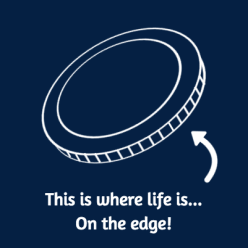 Imagine you and your brother are flipping a coin to see who gets the last dinner roll. Picking heads, you’ve predetermined that one side of the coin is success, while the other is embarrassing failure. As it floats in the sky, moving slowly through its parabolic arch, you salivate thinking about the melted butter on that last roll. And in this moment, the coin becomes kind of like Schrödinger’s cat’s coin, existing in a state of heads and tails at the same time. Both success and failure.
 This is just like the prototype that we want to test with our early adopters. Every prototype (no matter how ugly, how duct-taped together, or how functionality barren) has a chance of success. You’re setting your success metrics early and you know if you epically fail, at least you’re failing forward and learning. You let your prototypes live on the edge of the coin, why not you?
 Everyone has heard a tale or two of people with diverse, opposite appearances. The Frog Prince and the Beast can change form with true love, Dr. Jekyll and Mr. Hyde serve as faceted personalities of the same man, and Hulk smash when Dr. Banner gets mad. While the characters’ appearances serve as moral backgrounds for allegories and folk lore, there is a lesson to be learned here for innovators.
 Go Forth And Be Awesome