Being Awesome, Innovation, Team

How many C’s are there in “Innovation”?

Being part of a good innovative team is a dream. It is mutually rewarding, there are no stepped on toes or bruised egos, and everyone helps elevate each other’s ideas and projects to that “OMG wait until the world sees what were doing!” level. However, not all teams are created the same, and some are clearly created just to put sand in your sunscreen. I’ve identified four attributes that can help your innovation team reach new heights and upgrade into a traction-churning prototype machine!

Change

Making change sounds intuitive when working in innovation, but “change” is not just a product your team produces. Your team must embody change in order to stay relevant, effective, and productive. An innovative team that is set in their ways is like a brand new car in neutral; flashy and shiny now but ultimately going nowhere.

Change exists in your team procedures. There is no set template for innovation and what works today may not work tomorrow. Since variables and climates shift constantly, each problem you set out to solve needs to be evaluated for appropriate procedures for you and your team. Surveys and A/B testing of prototypes may have helped you understand your wireframes, but will those procedures help you learn about functionality?

Change exists in your team skills. Previously, we’ve talked about being T-shaped. If you are T-shaped, then your horizontal skills are where the change is going to be most noticeable. Those are the skills that possibly overlap with teammates, but are needed to fill in production gaps. Similarly, based on your proposed solutions that you need to prototype, you and your team may need to stretch beyond your skill sets into unknown territory. Sure, there are vendors out there that are experts in what you need to accomplish but they cost money. If you’re in the prototyping stage, you will need to weigh whether you can learn enough to create a testable prototype or if you need to spend the money. Either way, you should start learning about what you need, even if you chose to outsource work with a vendor. It makes communication easier if you have a basic understanding.

Candor

This can often be the hardest one for a team to develop because we want to encourage everyone. Yet not every idea, prototype, or hypothesis is a world-changing gem. Sometimes they’re just bland blobs of meh. That’s ok. You can still praise effort without agreeing with an idea. Try to level up the mediocre hypotheses and raise up your teammates. However, and I can not stress this enough, DO NOT LET THEM MOVE FORWARD WITH A STANDARD IDEA. You are doing them a disservice by not forcing them to make the idea better. You are passively undermining your whole innovation team. Likewise, you should prepare yourself for the time when your team will say your idea is “average” or worse. Candor is a two-way street. I am lucky that my team has saved me from shipping mediocre ideas. The best way you can show true respect for each other, is to demand each other’s best effort everyday.

“Life is way too short to make mediocre stuff. And almost everything that is “standard” now is viewed as mediocre.” – Seth Godin, Tribes

Credit

Innovation is lantern and unfiltered it can burn as bright as the sun. Nothing diminishes that light more than personal plans to receive recognition. In an innovative team, a team full of T-shaped dynamos, there is no room for ego and personal glory. When someone wins, it is because of the team. Just like a apple tree can not point to one rain storm as the reason it grew, your ideas are the product of the fertile soil in your brain and the collective brainstorms of your team in the past, event he unrelated ones. It is a bit cliche to say “There is no I in team” and it is quite futile because there are plenty of joke responses that defuse the power of the statement. However a team that is concerned about getting credit for individual contributions, wont contribute to the global good.

One great way to defuse this is to constantly recognize others for their contributions to your individual and team’s work. If people are constantly feeling appreciated for their efforts, then they won’t feel the need to find more recognition. It’s one of those “Do unto others” things. Plus, it’s just plain nice to do! Especially since you are working on an innovative team. Some projects you will lead and pilot. Others will find you following and pushing the project to gain momentum. And yet other projects will find you on the sidelines, cheering and consulting when you can. Team first, in every role.

Chupacabras

The Chupacabra of Innovation!

You need to allow the odd, the unique, the unbelievable, and the silly to integrate with your team. Hopefully your team of innovators is a group of positive deviants; bristling with energy to make a good change in the world. Chances are that the team has some ideas that are “out there”. They must be allowed to exist. Maybe an idea can be so wild that you won’t do it, but talking about it can spur the conversation down avenues you would have never considered before. One of our favorite brainstorming questions is “What would our industry NEVER do?”. We dance on the undiscovered edges of the maps, the parts where the dragons are supposed to live. We need to be the explorers of the fringe, the cultivators of the odd thoughts. That’s how we disrupt the market’s standard flow.

Challenge

  • When was the last time someone on your team said “This is how we always do it”?
  • What’s the most minimal way you can start to incorporate kaizen into your procedures?
  • A great way to start getting candor flowing is to be the first target. Put an idea out there and push your team to tear it apart. Have them find ways that it will fail. 
  • How can you incorporate a team-only view of recognition?
  • At your next brainstorming, challenge the team to come up with the worst ideas or the silliest ideas. 

Going Forth, Innovation, Prototyping

Paper Prototyping as a Creative Catalyst

I think we can all agree that Disney Pixar’s newest film, Inside Out, doesn’t merely tug at your heartstrings. Rather it grabs hold with a death grip and shakes them with a vigor that would make the Grinch weep, even prior to his heart enlargement. If you’ve not seen it yet, prepare your “It’s dusty in here” and “I got something in my eye” crying cover stories and go.

As you shed tears for Bing Bong (and you will) think of one simple fact… At one point, this story sucked.

These are the prototype figures I use for games. These have been knights, museum guards, venture capitalists, and more.

It was likely long ago, back in the early pitches and storyboarding phases. However, as Pixar Animation President Ed Catmull states “I’m not trying to be modest or self-effacing. Pixar films are not good at first, and our job is to make them so—to go, as I say, ‘from suck to not-suck.’” He adds “We dare to attempt these stories, but we don’t get them right on the first pass. This is as it should be. Creativity has to start somewhere“.

One key takeaway here is that we, as innovators, must start our creative idea somewhere, tell the story, and figure out how to get it “from suck to not-suck”. In fact, the faster we do this, the better. We don’t want to spend needless hours putting all kinds of sheen, gloss, and functionality into that first prototype because we will likely fail and need to pivot. That is why we need to prototype on paper.

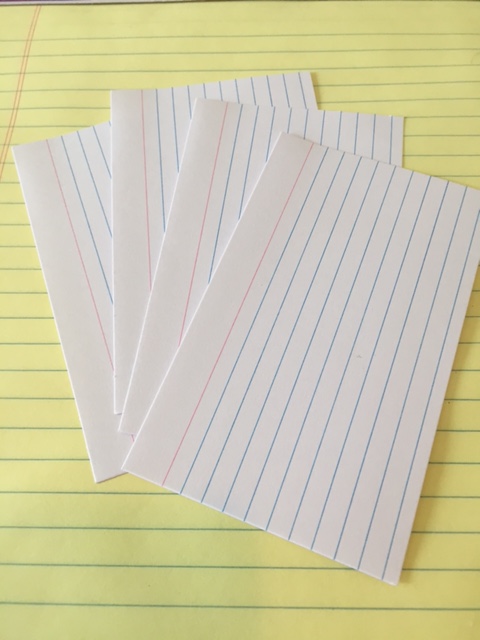
I’ve prototyped a few games just as a means to get an idea down, get it moderately functional, and to give the game idea some quick playtesting. I do not want to spend time or money in making beautiful, final quality game pieces because there are still many aspects that will need developing, balancing, or discarding. In order to prototype quickly, I keep a large stack of 3 by 5 notecards nearby (along with shiny glass beads, sparkly sticker books, and a plethora of dice). These become my makeshift game pieces. The best part is, they aren’t limited to prototyping games. A notecard could represent an app’s splash screen, an email template, or whatever you are innovating. There is always a way.

One quick note: Paper prototyping is a method, a way of making your ideas tangible in a quick, low-cost manner so that your innovative hypothesis can be validated. It does not HAVE to be paper, but whatever material you use should have the same inexpensive and recyclable nature.

Let’s take a look at some reasons why you should prototype of paper early, and often.

Notecards! A prototyper's canvas. These could be login screens, user profiles, or cupcake configurations.
Notecards! A prototyper’s canvas. These could be login screens, user profiles, or cupcake configurations.

YOU CAN PROTOTYPE CHEAP

Notecards can be bought for several on the dollar. This definitely beats the time and effort that would go into developing a digital or physical first version of your innovation. Imagine spending resources to have a first iteration of your innovation built, only to put it in front of some customers and find out that your solution needs some big time overhauling. Instead, if you had paper prototyped that primary version, you might be out a couple dollars. That’s a pretty decent Return on Investment for all the learning you can do with a first prototype.

YOU CAN PROTOTYPE FAST

There you are, sitting with a target customer, showing them your idea. You watch them interact with your prototype and you notice a huge flaw that needs to be addressed. If you’ve built a more elaborate prototype, this pivot can be costly and put a huge delay in your deliverable timelines. All those items in your kanban or development pipeline now have to sit and wait for this first one to be addressed. If you prototyped on paper (and remembered to bring notecards and pencils to your focus group) you can mock up the new screen or feature within seconds! Remember that you are just telling your innovation’s story  so these don’t have to be marketable graphics. They just need to be enough for the customer to see how it works and for you to watch them “interact”.  Plus this reduces your iteration time to something very minimal.

YOU CAN BE DARING

When you aren’t worried about cost of developing a prototype, and you aren’t worried about the time it takes to pivot and persevere into iteration two and beyond, then you can be as adventurous with your prototype as you want to be. You aren’t risking a ton of resources so put those ugly ideas out there! Be disruptive, do things the way no one in your industry does them. If your “out-there” idea crashes and burns, all you are out is a handful of notecards.

YOU CAN PUT THE FLOW IN THE CUSTOMER’S HANDS SOONER

This "paper prototyped" game card could represent your target customer's profile or maybe a feature within your innovation. You can quickly and easily make changes.
This “paper prototyped” game card could represent your target customer’s profile or maybe a feature within your innovation. You can quickly and easily make changes.

The best time to learn about your solution’s fit with your customers is when they are holding it in their hands. When your prototype only lives internally, it will always appear perfect. You need to kick it out of the nest and see if your idea can fly on its own. The faster you can do this, the less time you spend on bad ideas. Even if you don’t have it all figured out yet, get your core mechanics on paper and start asking your customers to look at it. It opens up new idea avenues for you to explore and it helps paint a better picture of what jobs the customer needs your innovation to do. We can all work on understanding our customer better, because they are always changing. Opportunities to learn and grow are valuable, especially when your innovation is in the very formative stages of its lifespan.

Later, we’ll go into some methods on “how” to prototype with paper… but for now, grab your notecards and start iterating!

Challenge

  • For this challenge, you will need 10 notecards.
  • Take 6 notecards and prototype the flow your customer will experience with your prototype.
  • Show it to someone and have them “pretend” its the real deal.
  • Iterate right then and there on any pain points they experience. Use your remaining 4 notecards for any additional or replacement steps in the flow.
  • Identify places you need to pivot and persevere and use more notecards to craft the next version!

___________

What materials do you use to prototype with? I’d love to see what is in your bag of tricks down in the comment section.

Being Awesome, Going Forth, Innovation, Motivation

Feed the Furnace

On a foggy night, he started his run 95 minutes behind schedule. He was determined to never arrive late vowing to “get there at the advertised time”. Illinois Central’s engineer had the tough task of making up over an hour and a half between Memphis and Canton. The engineer’s name was Jonathan Jones, but he went by Casey.

Casey Jones feeding his furnace.

Casey Jones’s heroic tales were reimagined in the 1950 Walt Disney Studios animated short, The Brave Engineer. In the cartoon, Casey Jones at one point jumps onto the front of the train to save a woman from the tracks. This was based on a true story where real-life Casey rescued a child in the same manner. Perched precariously on the cow catcher, his outstretched arms would scoop up the child who was frozen in fear on the tracks. Another exploit of animated Casey shows him ripping every part of his train down, from the cab to the caboose, and throwing it into the furnace of the locomotive… all in an effort to arrive on time.

We all have our own furnace inside of us. It powers our drive and brings our motivation to a boil. We do not have the convenience of a coal car that carries our fuel with us and Casey Jones had to tear down his own baggage car to get more out of his furnace. What can we do?

At the center of the furnace is a fire and fires in their own right are pretty great. You can build a camp fire and it will bring you warmth and light. If your fire is strong enough, others can gather around your fire. Go check out FAKEGRIMLOCK’s post about being on fire at FeldThoughts. The article is old by internet standards, but so is fire.

It boils down to this. You take the successes that you have and you take the failures that you have, and you use them as fuel. They help your fire burn stronger and brighter. But a fire on its own can burn low or the spark can go out. That’s why you can’t just feed it successes. Your fire has to burn off of the failures too. Especially in innovation where you will fail many more times than you will succeed.

Use failures as learning and fuel.

I don’t want my fire to just be sending energy out into the dark night. I want to use those Joules (unit of measurement for energy.. thanks Physics!) to make myself, my prototype, my blog, my quilting club better.

A furnace puts your fire to work.

Envision a furnace door mounted on your stomach. When you pull the door open, your internal fire can be seen. This is where you are going to toss in the successes and failures of your work. As a side note, I’m not saying to ball up your failures deep inside so that no one can see them. Hardly. I’m saying let those failures burn in your internal fire so that you have more Joules and you burn brighter. Then every one can say “Wow! You sure are glowing today!” to which you can reply “THAT’S BECAUSE I AM EMPOWERED BY THE EMBERS OF MY OWN FAILURE AND SUCCESS!” Or, you know, something to that nature.

Feed your furnace

When you feed your furnace, as Casey Jones did, you pick up steam and momentum. When your furnace is heated, your purpose starts to percolate. Purpose is one of the key components to motivation and when its is vaporizing because of the heat of your furnace, everything you do becomes more powerful. Sure you may need to pivot and persevere, here and there, as you fail and succeed with your innovations. However, neither one will be able to slow you down. You are an iron horse pulling 85 tons of ideas down the track of tomorrow. You’ve got a full head of steam and nearby towns can hear your whistle coming.

Just keep feeding the furnace.

Challenge:

Identify some places that you may have failed or succeeded.

How can you leverage them as fuel and keep moving forward?

Being Awesome, Innovation, Team

This Post is Brought to You by the Letter T

Joseph Greaser and I were discussing an article the other day. Over on the Game Development site, Gamasutra, Andreas Papathanasi wrote about Unleashing the Power of Small Teams. The whole article is worth the read because there are many gems. However I am going to focus on only one gem, The T-Shaped Person. Andreas talks about how he found this analogy in the Valve Handbook.

Valve looks to hire T-Shaped people for two reasons:

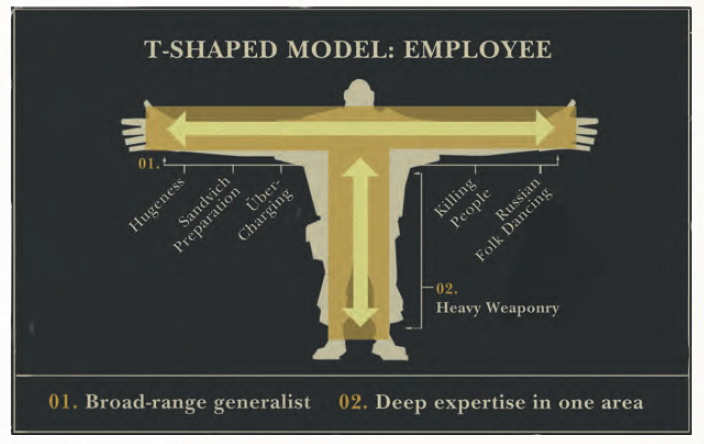
Valve's T-Shaped Employee, found in their handbook
Valve’s T-Shaped Employee, found in their handbook

1. A “T” has a deep knowledge and understanding in a skill area. Their knowledge here is so deep that they can contribute concrete ideas, solutions, deliverables within the skill area. You’re the best baker your friends have ever known? You’ve got the vertical part of a “T”.

2. A “T” has a broad range of knowledge across skill areas. They may not be masters of those areas, yet even some knowledge helps in communication, understanding of what’s possible, and often the eyes of a newbie can reveal the simplest solutions. This is the horizontal part of the “T”.

“T”s are especially useful on small teams or startups that are focused on delivering minimum viable prototypes. With their deep knowledge in one area, but broad knowledge of many areas, a “T” can construct testable prototypes easily. I may not have the development chops as some of my peers (I definitely do not), but I have enough knowledge to build prototypes that I can put in front of customers. You want to talk “minimally viable”? Have a “T” make you something from out on their horizontal branches.

Papathanasi went on to explain how the “T” exposes two other types of people. It shines light on people once thought to be “the best in the world”. We’ll call the first type “The Dash” because they consist of only the shallow horizontal part. We’ll call the second type an “I” because they have the deep skill and knowledge in one area, but don’t really understand anything outside of that. They prefer to stay within the wheelhouse. However I feel the “I” type can be broken down even further.

T is for Team
T is for Team

There are lower case “i”s that still have the deep knowledge, but sitting right on top of them is a dot. Dot = Period, Period = Stop. Holding them down is this dot that tells them to stop and go no further. Lower case “i”s have reached the point where the say “I’m good here. I can do this thing, and I’m happy with that.”

There are also capital “I”s that also have the strong vertical component, but they don’t have the dot sitting on top of them. No, they keep going up and up. These “I”s are looking to get better in their expertise area only. This can be extremely beneficial, but not on a small team. A small team needs everyone pitching in and doing jobs that they aren’t experts in to get the product shipped.

All of these types of people (“T”, “I”, “i”, and “the Dash”) have places on teams and can be extremely valuable to many organizations. Yet it is the “T” that is especially suited for a flat, small, innovative team.

Get a bunch of “T”s together and you get a platform you can build on ( TTTTT ), but if you put a bunch of “I”s together you will build a fence ( IIIII ).

So how can you become T-Shaped?

Let’s use the acronym FEEL because I had drafted my thoughts and was surprised that I could actually spell a word with the first letters. It worked out, so I’m going with it.

  • Fail – Yep! Fall flat on your face while trying something different. It’s ok. As Jake the Dog from Adventure Time says “Sucking at something is the first step towards being sorta good at something.” Remember when you learned to ride a bike? You undoubtedly fell then, and you will fall know. The trick is getting back on and broadening your T-Zone!
  • Experiment – Try stuff out. You’re not an expert so be cool with yourself just giving it a go. If you get some basic ideas down, try mixing and matching ideas. “What if I tried to make it do this?” Whether it falls apart or works flawlessly, you just leveled up in your T-Zone.
  • Explore – Wander into the unknown reaches of your work. If you know everything about your role, then you need to to explore into work-adjacent areas. Go beyond the edges of the map. You can either pick the brains of the other experts on your team OR you can see where your team’s skills overlap and leave gaps. This is fertile ground fro exploring because no one is currently in this region. Perhaps your prototype needs some video work done but nobody has video editing skills. Sounds like an opportunity to broaden your T-Zone.
  • Learn – Never stop learning. Your brain is like a muscle in that the more you give it something to workout with, it’s going to get stronger. You may not be an expert in your T-Zone… yet, but you could work up to it. Ask questions, read blogs, watch tutorial videos, you have a wealth of information at your fingertips. You found me, now I’m telling you to go find more!

Whether your small team is designing games or tea cozies, it will benefit from numerous T-Shaped people with different areas of expertise, but a culture of working outside the strengths to get prototypes validated. So fail spectacularly with your experiments in the unknown, because in those failures is where true learning lives.

Going Forth, Innovation, Persona, Pre-Mortem, Testing

I’m not dead yet!

I enjoy a good scary movie from time to time and zombies are everywhere. Zombies cause a load of difficult situations for folks. Imagine that you’ve just pronounced Steve* deceased, when all of a sudden, Steve sits upright and starts expressing his sudden love of brains. “My bad everyone” you might say sheepishly “I could’ve sworn he was a goner.” Then everyone rolls their eyes at you and it just gets super awkward. If only you had done a little more checking before, you might have a plan for when your “deceased” diagnosis failed.

Whether it is zombies or innovation prototyping, you need to do a pre-mortem.

The whole point of building prototypes and testing them with customers, is to see if you solution succeeds or fails. Yet we often wait to get our “failure folder” before we start thinking of why it went wrong and where the pivot opportunities are. There is no need to wait to make decisions when you conduct a pre-mortem.

Pre-mortems can help you plan if your prototype fails and comes after your brains.

Pre-mortems occur after your prototype is ready for testing, but before you do any actual testing. They allow you to take a glance at your work from a different angle. To this point, you’ve spent your brain power finding ways to get the prototype to work, how to demonstrate your hypothesis, and how to collect the data points you know are important. A pre-mortem let’s you stop those thoughts, and think “How can this prototype fail during the test and what am I going to do after it does?”

Pre-mortems focus your thoughts of failure to a single test of your prototype, not your end product. By keeping the scope of your vision on just one test, it is way less scary to envision the many ways it can fail.

A simple pre-mortem can be done by yourself as long as your prototype is in its testable state. However, it is very beneficial to have other people look at your prototype during the pre-mortem. These people are not your testers and they may not even be your target customer. Your pre-mortem pals are chosen because they have candor (which means that if it stinks, they’ll tell you… to your face… with no hesitation.) This group isn’t hyper-critical necessarily. They want to see you succeed, so they won’t inflate your hope with false niceties to avoid hurting your feelings.

If a person will tell you that your shirt is ugly, sign them up for your pre-mortem crew.

Executing a pre-mortem can be an informal process, however it is possible to ruin the validity of the pre-mortem. Be cautious to not “lead your witness” by building a worldview where your prototype is the only solution. You are best off not even telling them what your solution is or how it works. It is natural for us to go into pitch mode when we have someone looking at our prototype, but you wont be at the point of sale for your product every time. They will have to use your product by themselves, and “get it”.

Pre-mortems allow you to test your prototype, without any guiding, to see if it stands up on its own. A pre-mortem is like the first few shaky steps of a gangly giraffe; it looks like it will topple at any moment and you want to run over and prop it up, but you shouldn’t interfere if you want it to be running across the savannah someday.

To avoid the “let me just show you how this amazing product works” scenario, I’ve crafted a guide for you. This guide can be used whether you are “pre-morteming” by yourself, or with your group (the ones who are ok saying they don’t like your haircut).

THE GUIDE

  1. Refer to your customer profile so that you or your group can get in the customer’s mindset. Make sure to explain the pain points you identified for the primary persona.
  2. Let your pre-mortem pals interact with your prototype while you sit silently.
  3. Observe and document how they interact.
    • If you are doing this step virtually, have them write down or say everything that comes to mind including “Ok now I am clicking this button because it looks like it needs to be clicked… and now I am going to do this other thing”.
  4. Pretend to be in the future and your prototype has just failed in its most recent test.
    • NO REASON FOR FAILURE IS TO BE GIVEN YET.
  5. Have everyone participating in the pre-mortem write down how your prototype failed. Aim for lists with multiple failure options.
  6. Share and evaluate the responses. If you are doing this in a group, one person may see the prototype failing one way, and that may spark discussion on other ways no one had thought of.
    • I will warn you that this is a tough conversation to be a part of. However, you must encourage the dialogue. “This is great! Tell me more about how my prototype will fall on it’s face during the test!”
  7. Take your list of possible failures and start thinking of ways you can pivot.
    • Take no action now, unless a failure is eminent and will ruin the test. If that’s the case, you have to fix that! Otherwise, the list of failures is not guaranteed. Keep in mind that your pre-mortem pals may not be representative of your testing group.

If you are pre-morteming by yourself, you can skip steps 2 and 3. You should probably also skip any of the open discussion parts unless you want to talk to yourself out loud. And that’s totally fine if you do.

I enjoy pre-mortems. They teach you in so many ways. They serve as mini tests before your real test. They open up your eyes so that you can see your prototype from the customer’s point of view. They help you identify ways your prototype will stumble during the test. They let you plan pivots ahead of time, that you can act on later if your prototype does actually fail. I don’t dread testing prototypes because I know if it fails, I have a plan or two ready to go.

I challenge you to be vulnerable and find some folks who will look at your prototype with a critical eye. Plan for failure now instead of later.

*You may or may not know a Steve but I assure you that the names have been made up and any likeness to someone you know is purely coincidental.

Diffusion of Innovation, Going Forth, Grand Canyon, Innovation, Micro-Patterns, Persona, Understanding the Customer

Where did I leave that Grand Canyon?

My great friend, Joseph Greaser, posted an excellent write up about understanding your audience. Especially when it comes to innovation. You can read all about his case study and data that illustrate this point clearly. Read his post, follow his blog, and then come right back.

Flat, average desert
The Grand Canyon after averaging out with the rest of the land.

The next time you are stuck needing some small talk, here’s a little trivia for you. The average elevation for the state of Arizona is roughly 4,100 feet. Yet that fact covers up a big hole in the data. Actually, one of the biggest holes. The Grand Canyon is also in Arizona. Its elevation bottoms out at only 70 feet in the canyon. Now you’re saying “Of course it glosses over the Grand Canyon. That’s what an average does. It smoothes over the really high peaks and really low valleys.”

So then why do we use the average when trying to understand your customer?

The whole point of understanding your customer is to understand their pain points, their usage, and what innovations they would gain from. But if we keep just looking at average data to “get a feel” for how the whole group is using your prototype, then you could be missing grand canyons of opportunity.

Let’s change the lens for this. Imagine you are a teacher and you are looking at the grades for your students at the end of the year. Half of your class ended with a grade of 100%, the other half ended with a grade of 50%. Would you just average them out and say that your class earned a 75%? You wouldn’t unless you wanted to be looking for a different line of work in the fall. No, you would see two distinct “user-groups” in your classroom. Regardless of grade, both user-groups need your attention.

You would work hard to understand why it wasn’t working for your 50-percenters. You would try new things, different strategies, and observe to identify their pain points. Even your 100-percenters need you. You need to observe them as well to find what is working, try to push them to new territory, and give them some challenges. You would be doing so much to understand your students.

Similarly in innovation, we must journey to the bottom of data canyon to understand our customers.

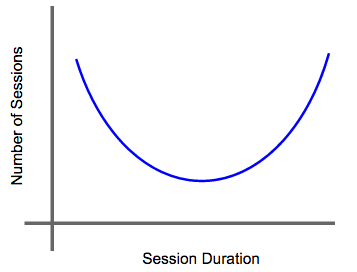
Let’s look at what the average leads us to. Based on analytics, a website was tracking an average of 5 minutes per session duration. Remembering what we can about averages from freshman year, we imagine the graph to look like this beauty.

averageExpected

Yet, through the magic of mathematics, this graph is also equally likely and just as valid.

averageUnexpected

Whoa! Talk about two completely different use cases for this website. Let’s put the graphs together to get the whole picture.

averageCombined

Only in some cases would innovating for the average actually provide some benefit to our customers. There are other valid cases where innovating for the average wouldn’t benefit the customers at all. Talk about wasted time, development, and effort.

Public Domain Image Rogers Everett - Based on Rogers, E. (1962) Diffusion of innovations. Free Press, London, NY, USA.
Public Domain Image
Rogers Everett – Based on Rogers, E. (1962) Diffusion of innovations. Free Press, London, NY, USA.

Another great example of this is to look at the Diffusion of Innovations curve. Ignore the extremes for now and look at what aiming for the average would get you. You would be nestled between the Early Majority and the Late Majority of customers. Your innovation would be targeting a user-group that is torn between being scared and skeptical of change. They would be wanting to get something out of your innovation, but at the same time they just don’t want to get left behind.

So what is a good innovator to do? One thing that we are always fond of is looking for micro-patterns instead of macro-solutions. Macro-solutions are the golden bullet, “this will work for everyone” type of product. These have their benefit in some instances but not when you are trying to understand your customers. Remember that averages smooth out the mountains and canyons that customers experience. Macro-solutions need averages to survive.

Micro-patterns help shed light on your customer personas. Go back to the classroom scenario, even though it is simplistic. Just looking at the grade data beyond the average shows us that their are at least two distinct customer personas in the class. It is ok to have multiple personas as long as you understand that they have different needs and desires from your product. The students with 100% grades have different demands from the classroom than the students with 50% grades. Your job as the innovator is to decide which group to innovate for.

The more complex your data is, the more micro-patterns there may be… and this is ok. Complex is neither good nor bad, it just is. As an innovator you aren’t here to judge numbers, you’re here to listen to their stories. And stories can be as deep as the Grand Canyon sometimes, but you have to make the trek to the bottom via mule to truly understand the customers there. Don’t let the shiny averages distract you with their homogenous targets for innovation.

Challenge:
Take a look at some data for your innovation.

  • What are some of the shiny, yet deceiving, averages that exist?
  • Dive deeper into your data. Are your averages glossing over some of the customer stories?
  • Try to identify the different, distinct user-groups for your innovation. List their pain points.