Being Awesome, Innovation, Innovation Mindsets, Like a Startup, Motivation, Team

How In-N-Out Burger Became My Innovation Anchor

What started as an impassioned plea to a team amidst a sea of chaos in a busy In-N-Out burger has become a rallying cry in the innovative process.
What started as an impassioned plea to a team amidst a sea of chaos in a busy In-N-Out burger, has become a rallying cry in the innovative process.

In the Spring of 2014, I traveled to San Francisco with some friends for a conference. I was raised on the West Coast, so any trip to California results in a required pilgrimage to In-N-Out Burger. It was a busy night at the closest In-N-Out and the dining area was packed with like-minded culinary aficionados.

We waited eagerly for our orders at the counter when you could feel the energy change. There were very loud “conversations” happening on the staff side of the counter. I couldn’t make out words but it was definitely heated from the chaos of the dinner rush. And that’s when our hero stepped in. He came from a spot in the back where he had been working the large, manual french fry cutter. He raised his eyes from the floor with the same erie calm that rolls over a seaside town before a hurricane strikes. Then we heard him proclaim, in all of our sight, a statement that’d change our mindset that night.

“We’re all… on the same… level.”

It is devious in its simplicity. This was not a time for hierarchical org charts or chains of command. Every employee there was tasked to get orders in, and then out. In and out. It was not about pulling rank or telling others how to do their job better. Get the orders in, and then get them out.

That simple statement has anchored the better part of a year and a half of innovation theory development. It has become a mantra, a safe harbor, and a compass. Here are the two best applications of “We’re all on the same level.”

1. Your team is all on the same level.

Hopefully you’ve had the opportunity to read my post on T-Shaped teammates and flat teams. If you haven’t it is located here.

Having a flat team has many benefits, specifically in the deployment of candor. Without a designated manager or leader, each person feels comfortable offering up bad ideas as well as critical feedback on other prototypes. Open dialogue helps the team move faster towards promising solutions.

A wise person once said “A good idea doesn’t know its parent.” An individual on flat team doesn’t seek credit and instead uses any success to reflect back on the team’s efforts. Another benefit is that when tasks or events arise, everyone is willing to pitch in. There may be tasks above or below the team’s station and if they are an honest-to-goodness flat team, then there will be shared coverage of those tasks.

The team functions for collective goals when they’re all on the same level.

2. The problems you try to solve are all on the same level.

There are two main schools of thought around innovation. You either start with a solution or you start with a problem. The majority of what I do starts with a problem. It requires me to research the problem and empathize with the customer, because sometimes the problem you see is not the real problem. There are problems that seem cut and dry. Slap on a salve of solution and you are good to go. Then there are problems that look dark and wrapped in a bramble of thorns. But here’s the rub. If you have an effective process for tackling problems, then all your problems are on the same level.

The simple problem does not get a watered-down, vanilla version of your process. If your process works, apply it to the small problems.

The tricky or large problem does not get additional steps or tools applied to your existing process. If your process works, apply it to the large problems.

It minimizes to this: If you are trying to solve a problem, apply your effective process in its best and truest form.

Keeping things all the same level reduces politics and favoritism, and helps promote candor and openness. And to borrow one of Walt Disney’s famous quotes… “It all started with a burger.”

Challenge

  • Are there things that you put at different levels?
  • Would rearranging them all on the same level affect your innovative process?
  • When faced with a new problem, ask yourself “How would In-N-Out solve this?”

Being Awesome, Brainstorming, Diffusion of Innovation, Ideation, Innovation, Understanding the Customer

Innovating with the Uninterested

My kids send me strong signals all the time. For example, when we have broccoli or sweet potatoes, they respond with very strong signals. Unfortunately their signals are strong AND negative. One way we’ve tried limit these anti-veggie reactions is to get them involved in the meal planning.

Like in meal planning, we should be looking for strong signals with prototype tests. Strong signals validate that solutions are worthy of digging into deeper. Sometimes, you will get responses of “I don’t like this” or “I’m not sure this will work.” These are great strong signals, just not the ones you may have been looking for. Their value though can be immense.

diffusionOfInnovationLooking at the Diffusion of Innovation, these types of strong signals would be achieved from folks in the “Late majority” category. That accounts for 34% of the market, and yet we design by relying on “Early Adopters” or the “Early Majority”. How can we move their timeline of adoption up? How can we use their strong signals, and their personas, to help make our prototype better?

We can design with them!

Wrangle up some of those “This will never work” naysayers and get them in an ideation session. You can often get them to agree by just being honest. No need for trickery or bribes. Just tell them that you’re sorry your one idea didn’t fit for them but you’d like to understand their view better.

“Great! Now I have all the people who hated my prototype in one room. What do I do now?”

It is simple, just understand these three guidelines.
  1. Let the customer drive the conversation
    Strong signals, like kids rebelling over the inclusion of broccoli, can indicate the presence of the "Late Majority". Instead of taking a hit to your momentum, use their energy to design a new, better solution!
    Strong signals, like kids rebelling over the inclusion of broccoli, can indicate the presence of the “Late Majority”. Instead of taking a hit to your momentum, use their energy to design a new, better solution!
    • You must aim for a 80-20 ratio of listening to talking.
    • Listen to understand, not to react.
      • This is a personal pet peeve, but too often we listen with the intent of reacting to what someone says. Especially here where you’ve already show the customer a solution. They will say “Well I need it to do X.” and you’ll want to say “Well what I showed you will already do X, you may have missed it.” AVOID THIS! Internalize that thought but come back to them with something like “Interesting. When it does X, what does that look like to you?”
    • Reiterate what they say if you are unclear.
      • Remove any uncertainty.
    • You may need to set up the ideation session with some easy wins up front to grease the gears of innovation.
  2. Keep their options limited
    • Too many options and they will freeze up. It’s a cousin of the “blank page” syndrome.
    • Constraints can also help people be creative.
      • It’s like squeezing a tube of toothpaste. Applying pressure, with the constraints of the rest of the tube, pushes the paste onto the brush.
  3. Nothing needs to be pretty
    • An “ugly” prototype or a napkin sketch keeps the customer from thinking the idea is set in stone.
    • Thinking everything is “up for change” frees them up to make more suggestions.
    • Encourage them to take a crack at some wireframes.
      • You will hear “I’m not good at drawing” but we’re not looking for art here, just ideas. You can offer to draw for them if this is a sticking point.

I’m not saying you’ll end this process with a market-capturing design. But you will have a better understanding of the needs, the pain points, and the potential gains for your innovation with the Late Majority. Imagine if you can inspire the Late Majority to adopt sooner!

Failure, Going Forth, Innovation

Vanity Metrics & Bathrooms: It’s not the size of your mirror.

Numbers never lie. However numbers can be misleading, even when they don’t mean to be.

One thing that my good friend Joe Greaser has often said “If someone is bragging about their data, it is probably a bunch of vanity metrics.”

Eric Reis (Lean Startup) brought the term “vanity metric” to light. They are the metrics that sound really good, but in the end don’t amount to much. In contrast to vanity metrics are the actionable metrics. These metrics are tied to specific actions or tests and inform you on what to do with them. “My app has had 50,000 downloads.” Vanity metric. “I tested two versions of my app and customers purchased 40% more through the B version.” Actionable metric.

Another one of my good friends, Mike Jarrell, was going to a sporting event where they were promoting stadium upgrades. “87% more female restroom facilities and 20% more male facilities!” At first glance you say “Wow! They really understand that lines for the women’s restroom at sporting events can be painfully long.

But are we falling into the trap of vanity metrics?

Let’s take this to absurdity to prove a point. Assume that Innovation Stadium has 5 female restrooms and 20 male restrooms. Pretty unlikely and unreasonable, I know… but we’re imagining the absurd here. Stick with me. Now let’s agree that Innovation Stadium added 5 more female restrooms and 5 male restrooms. The grand totals are still unbalanced at 10 female restrooms and 25 male restrooms. And yet Innovation Stadium can claim “We’ve added 100% more female restroom facilities and 25% more male facilities.” Sound familiar? Not saying that’s what happened, but sometimes you pick the numbers you want to market.

What sounds better? 5 more female restrooms or 100% more?

Recently, TechCrunch posted about the math behind startup valuations. This is an amazing article, especially for a mathy like me. And I have no doubt that these calculations are reliable within certain parameters. I want to point out my one concern. The article says that without enough customers, a startup has to use estimations. Believe me, I get it. You have to estimate sometimes, especially in a new business. However, if any startup bragged about data calculated from estimates, then they too have been wooed by vanity metrics.

It reminds me about how quark-sized some baseball statistics have become. Almost to the point where a batter can walk to the plate while the announcer tells you his batting average in the month of August, with runners in scoring position, against pitchers with a weekend birthday this year, when they’ve gotten a call from their mom before the game.

Vanity metrics may look good, but they lure you into dangerous assumptions of success.

In innovation, we don’t have the kind of time baseball has. They have a 162-game season to see their statistics play out. In innovation, you’re lucky if you have a couple weeks. Build, test, measure, learn… sprint, sprint, sprint. So how do we avoid vanity metrics?

  1. Establish what hypothesis you are testing, before you test.
  2. Identify what metric, or metrics, would absolutely validate your hypothesis.
  3. Now you can test your prototype.
  4. Collect, reflect, observe, and analyze.
  5. Be ok with failing forward.

By setting the hypothesis and success metrics before you test will prevent you from latching on to bright spots. Also, by being alright with failing (as long as you are failing forward) then you feel less pressure for each test to be successful or be validated. It is a tough practice, because you’d like your idea to be a winner, but this is all part of the process in finding the right solution. Remember, you’re refining an idea that will work, not just pushing your favorite to the finish line. So be modest, avoid the vanity metrics, and keep it all actionable.

UPDATE!!!

So here’s something pretty applicable. Early today, another good friend of mine, Adrienne Campbell, and I had a great conversation about this post. I am lucky to have many good friends who:

  1. are deep thinkers
  2. challenge me and make me think deeper

We were talking about vanity metrics and if there really was a good use for them. Maybe they don’t need to be avoided at all costs. Perhaps they could provide some value.

Take a look at this example.

A vanity metric for blogs would be the number of views. This is a great statistic if you are looking for overall exposure and reach. “Should we promote on Blog X? How many views do they get?” A great actionable metric would be “How many excellent conversations came out of a post?” (that’s one from today!) or “When I write about Subject A, how many views do I get compared to when I write about Subject B?” I get more views in WordPress when I write about writing. I get more retweets when I write about innovation processes. This is data I can act on.

Something Adrienne brought up was (and I’m paraphrasing) “Different metrics are appropriate depending on the purpose.”

  • Want to know if your prototype is working? You need to locate actionable metrics to test.
  • Want to promote your solution to an outsider? There may be some vanity metrics that get the conversation going.

It brings it all back to the stadium restroom example. They probably justified the construction based on actionable metrics such as length of wait and restrooms per person, but they promoted vanity metrics by promoting the percentage increase.

That means both can be a welcome tool in your innovative tool box. You just have to know when to use which one. ~GFandBA

Going Forth, Innovation, Innovation Mindsets, Sustaining versus Disruptive

Thinnovation

This past week, I was talking with the main man in charge at Mastermind Games, Mike Jarrell. He has recently released a trailer for the upcoming game, Affliction. In the midst of the conversation, Mike paused and shared his snack of choice that day. They were Oreo Thins. He commented that they had spent all those years double stuffing, and max stuffing, to come to this… half stuffing.

I don’t know if you’ve had Oreo Thins, but they are quite different. I expected just less filling, but the cookies themselves were slimmer and crisper. It actually lends itself to a different experience. Now before you wonder if I’ve gone off on a cookie-fueled foodie rant, let me ask you this question:

Are Oreo Thins an innovation?

When I stood in the cookie aisle looking for the Oreo Thins, I noticed that there were no less than 15 or so different varieties of Oreo. From different amounts of stuff to different flavors of stuff to different types of cookies. But can remixing and slight alterations to an established product really amount to innovation?

Yes… and no.

There are two types of innovation: sustaining and disruptive. Sustaining innovation is what Oreo is good at. It is slight manipulations to keep the product fresh, introduce new features or variants. Sustaining innovation goes after the existing market and strengthens their position in it. Oreo is using sustaining innovation because they are operating with a red ocean strategy. This is an ocean they are already in, competing with other snack food “sharks” in a feeding frenzy for consumer dollars.

However, there is another wide open ocean out there, a blue one where disruptive innovations could take them. Disruptive innovations take the existing flow a customer expects and breaks it in a new, exciting, and unexpected way. Oreo’s don’t seem to explore blue oceans very often, so let’s take a moment and pretend they did.

Alternate Futuristic Oreo Timeline

Remixing the same ingredients is ok for sustaining innovation, but what if you want to disrupt to cookie business?

When I went to purchase the Oreo Thins for “product knowledge” I was instructed to bring home some Oreo Double Stuf as well, because that is the Official Cookie of our house. I can only imagine that across the globe, there are homes divided by their Oreo preferences. Imagine if Oreo planned to ease this tension with the Oreo Your Way. The Oreo Your Way is a pack of just the cookie wafers, all clean and crisp, and separately sealed tub of cream filling. Commercials would feature everyday people talking about how they Oreo. How much Stuf they use, the different configurations. Oreo then solidifies itself as a snack food that allows you to express yourself. The onslaught of selfies with unique Oreo combinations alone could topple servers from here to Walla Walla.

Then Oreo would take it even further. By starting with the Oreo Your Way, they’ve unlocked the whole hand-crafted, artisanal movement that has ensnared almost every other food group. This is when they unleash Oreo’s Manhattan Craftsman Biscuit. The design harkens back to Oreo’s humble beginnings in 1912. Each cookie is composed of top-quality ingredients, and assembled by cookie architects who sculpt the filling. They are artists themselves and sign each bag since each artist has their own style; a signature flair. This sleeve of cookies sells for nearly twice the traditional sleeve of Oreo’s.

And now Oreo has found two blue oceans. One where they let the customer take part in the personalized assembly of the cookie, and one that caters to the high-end and scarce, hand-crafted market. And while I enjoy a box of Oreo Thins that need some more “product research”, I will await your call Nabisco.

Challenge

  • Is your innovation a sustaining or a disruptive one?
  • How can your innovation use the red ocean strategy?
  • How can your innovation sue the blue ocean strategy?
Being Awesome, Ideation, Innovation

Open Your Doors Before You’re Ready

You ever have one of those ideas that floats around, just kind of dancing in your brain, eager to be released? You can coax the idea to calm down for a little while by saying “Ok, I’ll let you out, but I have to have this one thing in order first. I want you to be a success!” And so your idea calmly sits while you prepare. It’s not long afterwards that your idea gets anxious again, and you have to encourage it to calm down once more. And this cycle repeats. Why?

I’ll tell you why. We have this fear that if everything is not just right, our idea is going to fall flat on its face. We lose too much while waiting for the “right time”. However, by waiting we’re only building more anxiety that our idea must be perfect when it is released. We need to spend less time with our ideas “on the ground” and get more of our ideas soaring “in the air”.

Early adopters don't care if you're 100% ready. Get those doors open and let you idea gain some traction in the real world.
Early adopters don’t care if you’re 100% ready. Get those doors open and let you idea gain some traction in the real world.

In 1966, a shoe store opened in Anaheim, California. They saw 16 people walk in the store that first day and 12 of them made a purchase, and yet the shoe store didn’t have a single shoe in the store. They had samples of the different styles, but nothing the customers could leave with right then. Instead, the customer placed an order, the store would get to work making the shoes, and the customer could pick them up later that day.

The store only operated like this for the first couple days, but the owners simply couldn’t wait to open. The doors were flung open as soon as the store could be open, there wasn’t time to wait on actually having shoes. In fact, the shoe samples didn’t even have names. They were just design numbers like #44 or #20.

And that is how Vans started.

You see, Paul Van Doren, James Van Doren, Gordon Lee, and Serge D’Elia didn’t want to wait until everything was perfect. They wanted to get their idea out there so it could breathe and run and live.

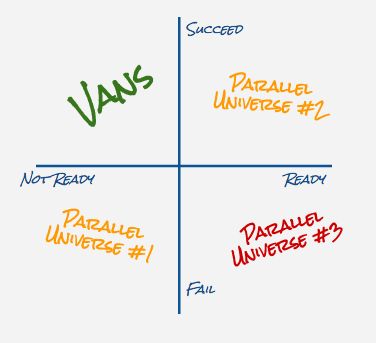
If we twist the story just a little, we begin to see the brilliance. We’ve already seen what happens if they open early and succeed, but there are three other parallel universes out there.

  • Parallel Universe #1: They open early and fail. No harm, no foul. They don’t have a surplus of shoes that they need to unload or wear for the rest of their lives. Not as bad an outcome as bad outcomes go.
  • Parallel Universe #2: They wait until they craft all their shoes and succeed. This is a boring story because there is nothing surprising about it. Nobody took a chance. This is like following the on-box directions for macaroni and cheese. No one is surprised when it comes out as macaroni and cheese. This is routine and nothing of note can be gained here. Move along.
  • Parallel Universe #3: They wait until they craft all their shoes and fail. This is the evil timeline. They lose a ton in this version of the story. Money, time, materials. Think of all the extra shoes that they can’t sell! In this universe, all their cousins and nieces and nephews are cautious around birthdays. “Uncle Paul is coming? He’s probably going to give me another pair of those shoes again.”

failvsreadygraphBy opening the doors early, they ran the best chances at success. And this will please all you managers out there, by opening early they mitigated the most risk. They had an opportunity to validate their ideas before spending resources to make the idea perfect.

That’s what we’ve got to do as innovators. We may have an idea that we’re sure will flip the market on its ear and make the world a better place to live in. But the longer it is just an idea, the more time the market has to catch up or diverge. There is nothing worse than spending years on an innovation to launch it and have the market say “This solution exists already” or “We don’t need this solution anymore because the problem has changed.”

If you need further convincing about opening your “idea doors” early, you don’t even have to leave Anaheim. Just travel back in time from Vans in 1966, to Disneyland in 1955.

As the gates opened for the first time on July 17th, Disneyland faced these problems and more:

  • some trees had just been planted
  • some of the paint was still wet
  • counterfeit tickets doubled the number of guests expected
  • water fountains didn’t work because a plumber strike meant only the bathrooms would be functional
  • the asphalt on Main Street had only been poured the night before

The myriad of challenges Walt and his team faced on Day One were used as a learning opportunity. A chance to figure out what wasn’t working. Shouldn’t we afford our ideas the same chance? The same opportunity to learn and grow from the challenges? We’re supposed to be embracing failure, so let your ideas out into the sun!

I’ll close with the words of the immortal bard, Shia LaBeouf. “Don’t let your dreams be dreams. Yesterday you said tomorrow so just do it. Make your dreams come true.”

Go forth! Be Awesome! Feed your furnace!

Challenge

  • What idea has been living in your head for too long?
  • What can you do today to get it out into the world?
  • What can you learn from sharing it with someone right now?
Empathy, Innovation, Lenses, Persona

Buckle Up for Empathy

Loading the family into our Swagger Wagon (ok… minivan) I asked my oldest son to help my youngest son buckle his seat belt. I want to recognize as many “I can do it myself” statements as I can, but not when were in a hurry. That’s when I lean on the buckling-up experts to lend a guiding hand. My oldest quickly assesses what I asked him to accomplish, grabs the buckle, and promptly drives it home with the satisfying click that means “all safe and secure”. However in doing so, my oldest had pulled the strap across the face of my youngest.

But, as they say in the American South, bless his heart. He did precisely what I had asked. “Please help your brother buckle up.”

  • Task? buckle brother’s seat belt
  • Status? accomplished
  • Brother’s feelings? not in the scope for this mission

I say this not because I want to tell a cute story about how goal-driven my oldest can be sometimes, or about how my youngest has the resilience and facial elasticity to bounce back from this. I want to highlight that this is a trap we all fall into as innovators.

We listen to our clients, our customers, our primary personas because we’re good innovators. That’s what we do. However sometimes when the customer says “I want a product that does X”, we head right into the prototype factory and make Product X. And then we are flabbergasted when Product X fails to capture the market.

What we need is more empathy.

Empathy is all about understanding the customer’s worldview. We can gain a better understanding by observing the customer in the situation and taking note of what they say, think, do, and feel. Check out Stanford d.school’s empathy map for more detail.

“If I had asked people what they wanted, they would have said faster horses.” – Henry Ford (?)

We can not focus solely on the function of buckling or what the customer says they want. We must have empathy for the person in the seat and understand their potential pain points.
Empathy keeps us from taking the customer at their word and let’s us get at the heart of the problem. Like the quote attributed to Henry Ford suggests, we don’t want to give them faster horses. We want to understand WHY customers say they need faster horses. What job is the horse doing and why does it need to happen faster? The more we drill down into the empathetic questioning, the more we can find the true cause of the problem and actual working solutions.

My oldest is a very caring person, but in this case he simply listened to what I said, and made that happen. He did not think “Why is dad asking me to buckle him in this time?” nor “What’s going on with my brother that I need to help?” He did not have to buckle innovatively. I wasn’t looking for a new way to secure my children in their car seats. However, with a little more empathy he would have noticed that an immediate solution was not going to be the most optimal.

It is not innovative to have a customer ask for a faster horse and just deliver a faster horse. What customers say is only one-fourth of the puzzle. In the Value Proposition Design framework, Innovation is when a customer asks for a faster horse, you dive into what jobs the horse was doing, what pain points the speed of the horse was causing, and what opportunities for gains existed in the current horse-driven model. Innovation is disrupting or challenging the flow of the current model with a solution that gets at the root of the pain felt by the customer. Delivering what a customer wants is not the job of the innovator. Our job is to find what they need.

Innovation ignites when empathy is your spark.

Challenge

  • What does your customer say they want?
  • Identify the pain points that are leading them to voice this need.
  • Find an opportunity to observe your customer and take notes.
Being Awesome, Chupacabra, Innovation, Motivation, Theme Park of You

Be the Theme Park of YOU!

If I was to ever start a theme park, and let’s say my mascot is Chupey Chupacabra, I’d be 100% sure to offer a goofy looking Chupey Chupacabra hat. Every theme park has their own trademark-toting version of the Chupey Hat because tourists eat those kinds of things up! They will spend some hard earned cash on items they will only wear while at a theme park. Folks, this is a hat you will never wear again… yet you will wear it for the length of your vacation until a permanent indention forms on your forehead from the sweatband. You will shriek in panic if you leave it behind on a ride. You will run back to your hotel to grab it before you dinner reservation at our five-star restaurant.

But why?

You won’t wear it while shoveling snow in Pocatello, Idaho. You certainly wont wear it walking down the street in Dover, Ohio. There is a special aura that theme parks give off, especially in their merchandise. So what makes theme parks such a hot bed for impulse fashion decisions?

For only $19.99, you too can wear the Chupey Chupacabra Hat all around the theme park. You'd never wear this at home, but in this theme park it is enchanting!
For only $19.99, you too can wear the Chupey Chupacabra Hat all around the theme park. You’d never wear this at home, but in this theme park it is enchanting!
  • For starters, they are telling a story that tourists can get into. Tourists are allowed to have fun, believe, and pretend.
  • Also, there is great power in being surrounded by like-minded others.
  • Lastly, everything the tourists are experiencing enhances and pushes the story further. The theme park supports and enables the Chupey Hat culture.

We need to capture this for ourselves! We need to tell stories about us that others can get behind. We need to give people are reason to believe in our ideas, our innovations, our plans for the future. We need to foster the culture around us so that our supporters aren’t one or two individuals, but rather a massive crowd gathered to watch a parade and maybe some fireworks later. And because they’ve gathered, we need to show that we can drive the story, ideas, innovations further. We are going to reward and support those who carry our banner.

And yet, when tourists go home, they put their Chupey Hats and other souvenirs away. So how can we lengthen the effects of their Chupey Hat? How can we recreate the excitement of our rollercoasters of innovation?

There are two paths: We can give them a take-home version, or we can encourage and enable repeat visits.

  • Take-home versions are compact, often watered down, and don’t affect their worldview. At best, take-home versions are distractions to their daily life, if they have time. They will most likely be put in a box in the garage and then reminisced over when they are told to clean the garage because we can’t park a car in this mess.
    • This path is not effective, yet. I think it could be reinvented to be more optimal.
  • Repeat visits encourages them to take care of their Chupey Hat. It deepens the hold the story has within their heart and mind. Someone who visits repeatedly is more likely to have memorabilia all over their house. They are planning a return visit to the theme park of you before their current visit is over. They are probably stock holders; they are invested in your success.
    • This is the good path!

As I am writing this, I can identify who wears the Chupey Hats in the theme park of me. They are amazing people and I’m honored that they even visit much less be such adamant supporters. However I can not rest on my laurels. I have to add new rides, I have to give them better experiences. I’ve got to expand and develop the Chupey Chupacabra storyline because these tourists are the early adopters. And what they’ve early-adopted was a belief in me.

Challenge

  • What is the main story in the theme park of you?
  • What kind of merchandise can we get in the theme park of you?
  • How are you going to make tourists want to come back?
Being Awesome, Innovation, Innovation Mindsets, Lenses

Paint the Fence as a Beginner

Daniel didn't balk at starting his own bonsai tree when Mr. Miyagi offered. Even though he was a beginner, the vision for the tree still lived in his mind.
Daniel didn’t balk at starting his own bonsai tree when Mr. Miyagi offered. Even though he was a beginner, the vision for the tree still lived in his mind.

The 1984 Columbia Pictures classic, Karate Kid, obscures an awesome tidbit that I had not caught before this week. The movie glosses over quickly the fact that Mr. Miyagi had never taught anyone karate. Not until Daniel needed to learn that the secret to karate is in the heart and mind, not in the hands. This is the movie’s most memorable character arcs, as Daniel learns karate while sanding the deck, waxing the cars, and painting the fence.

Mr. Miyagi does not have years of proven methods to train Daniel with. No, he thinks outside the box to give Daniel hours of practice developing strength and muscle memory. That’s because Mr. Miyagi, whether he knew it or not, was employing shoshin (the beginner’s mind).

The beginner’s mind is something we need to embrace as well. No matter if we are trying to convince an innovation from the caves of our minds to bask in the light of day, or if we are just looking to go forth and be awesome.

Try taking on a new skill and expanding what you can do. Broaden your T-shaped self. By venturing into new territory, you activate your student mindset. You look at items with fresh eyes. You are unburdened with years of “this is how we’ve always done it”. Of course those first few steps in your chosen new skill are awkward and unstable. But you get to revel in the fact that this is part of the learning process!

“Dude, suckin’ at somethin’ is the first step towards bein’ sorta good at somethin’.” – Jake the Dog, Adventure Time

Thinking differently is at the root of innovation. It happens in multiple ways. The traditional way is when someone gets so upset with the status quo that their thoughts break the boundaries of the typical box. They start to think of how everything can be better. These are the heretics that go against the rules. (Heretic in this sense meaning someone who goes against what is generally accepted)

Another road to innovation is when the tide of shoshin rises. Seeing things as a beginner means you don’t shy away from the boundaries. In fact you push on them to see if they give. This often leads beginners to solutions experts can’t see. Experts are weighed down by proven paths to success. To a beginner, all paths are viable from where they stand… so why not try a few?

So engage your shoshin, be a beginner at something. Then start applying that new viewpoint to your innovation. Who knows what solutions you’ll uncover?

Challenge:

  • What skill would help your innovation move forward?
  • What can you do to start learning that skill?
  • Early in your learning, look at your solution again. Are there new hypotheses to validate?
Going Forth, Innovation, Motivation

Any Given Second…

Time wages war against us innovators with an endless army that surges forward, claiming the hours, the minutes, and the seconds we could be using to change the world. They get consumed by Time’s horrific horde, never to be seen again. Insomnia sometimes feels like a blessing because you can get up and work on your project undivided. At least it beats laying your head on your pillow, ruminating that every minute spent sleeping is another minute your prototype sits undelivered, undeveloped, and untested. But if you’ll allow me to remaster Al Pacino’s speech from Any Given Sunday, “The seconds we need, are everywhere around us.”

Innovation, reinvention, lifehacking… what ever your angle is on it, needs time. And unless you are part of the lucky few who get to professionally power think tanks with battery-like brains, you need to find time in the nooks and crannies of your schedule. It may be small, but time is there for the taking. Take a look at the newest illustration by Zen Pencils.

Is that not worth exploring? by James Rhodes, Illustrated by Zen Pencils

What I like best about what James Rhodes said was that the time was still spent on the required activities; work, family, sleep. Even after all that there were still six hours in the week that could be devoted to something personal. In the context of this illustration, it was learning the piano. In our context, it will moving your innovation forward.

“Lost time is never found again” Benjamin Franklin

Seconds melt away and in the hourglass of life, it doesn't get flipped over. You have to make each. grain. count.
Seconds melt away and in the hourglass of life, it doesn’t get flipped over. You have to make each. grain. count.

If you are a weekend warrior innovator or you scratch your creative itch at work with side projects, this post is talking directly to you. I myself have a creative role, and yet in my spare time I find creative pursuits that I don’t get to chase at work, like boardgame design. Whatever your dream is, whatever your product is, the longer it sits in your brain is the longer your dream goes unrealized. Who would have thought that the biggest obstacle to your goal, would be you? I want to encourage you, to get your idea to go forth.

Think of your idea on a treadmill in your head. There it is, churning away. “Wouldn’t it be cool if…?” Yes, yes that would be cool! So let’s get some traction going. Yet, your idea continues to churn on the treadmill. You see, if it keeps heading in the same direction it’s always gone, it will stay where it has always been… in your head. For your idea to move to new places, it has to step in a different direction. And you need time to move in those new directions. So grab the time when you can find it. Don’t miss an opportunity to be awesome.

We spend so much of our free time consuming the awesome that other’s have created. We binge on shows, we like our friend’s witty posts, we spend hours watching other people play video games on You Tube. And there is nothing wrong with that. They say to be a good writer, you must be a good reader so it would make sense that to be innovative, you must be involved in other people’s innovations. However, let’s look at what Stephen King said.

“If you want to be a writer, you must do two thins above all others: read a lot and write a lot.” Stephen King

It isn’t about just consuming, you have to create also. It is two parts: you must research and you must do. So take some of that free time and put it towards your innovation. Start paper prototyping your innovation. Plan out some testable hypotheses. Just talk to potential customers about their pain points. it is all about gaining traction, moving your idea ahead, going forth, and being awesome.

Challenge

  • Evaluate your daily activities
  • Identify some times where you can work on your innovation
  • Set a reminder on your phone/calendar/refrigerator
  • Stick to your appointment!
Being Awesome, Innovation

Status Quo Dies Hard: With a Vengeance

Cool guys don't look at explosions, or validated hypotheses from minimum viable prototypes.
Cool guys don’t look at explosions, or validated hypotheses from minimum viable prototypes.

The clock ticks down… 00:07, 00:06, our hero grabs the secret briefcase and kicks the evil mastermind sprawling to the floor. 00:04, 00:03. “Seems like you forgot to study the map with the escape routes!” the villain cackles. Our hero runs towards the walls of the mountain-top base and looks hundreds of feet down the cliffs to the ground. “I don’t need to study” he says while looking back at the villain. 00:01 “I’ve got the cliff notes.” 00:00 He leaps over the wall, his tuxedo transforming into a paraglider as he is silhouetted by the massive explosion behind him.

Whew! What a cliffhanger! (See what I did there?) Action adventure stories can leave us with a rush of excitement and adrenaline, whether they are movies or books. This past week I was able to attend a local meet-up of writers. The topic of the day was action adventure heroes and plot structure. It was an excellent discussion but my mind kept coming back to innovation.

For example, in action adventure stories, there are good guys and there are bad guys. It is a clean division of Team Yay and Team Boo. The hero, solidly in the Team Yay category, doesn’t wan’t to understand the bad guys. He wants to defeat and eliminate them. The story usually takes place in a unique location that the hero is not one-hundred percent comfortable; it is not his home turf.

At this point, a light went off in my head. Take those points about the hero in action adventure stories and portray it as someone against innovation. There are clear distinctions between what they support (this is Team Yay because it isn’t risky) and what they don’t support (this stuff is Team Boo because it scares me). Our anti-innovation “hero” wants to defeat and eliminate the risky items on Team Boo. And in fact, this usually occurs when data or trends are suggesting that change is happening around them, making the market hostile to this person.

So many parallels. And then this brain-bolt struck.

In an action adventure story the protagonist doesn’t grow as a person over the course of the movie/novel. There is no realization that a different solution may work. Rambo never wants to talk it out. James Bond never invites a woman over to just watch Netflix. Indiana Jones never seeks therapy to overcome his fear of snakes. (I think its connected to early childhood trauma from taking his dog’s name as his own)

Action heroes are a metaphor for the fight against change. They are a protector of reader’s/watcher’s mental status quo.

“Life is too short to fight the forces of change. Life is too short to hate what you do all day.Life is too short to make mediocre stuff.” Seth Godin, Tribes

So just remember that to some, we innovators are seen as the bad guys. We challenge their worldview, we smash the status quo, we trod down paths that don’t exist yet. Our task is to take out-of-the-box ideas and pitch them in-the-box. And sure, these action heroes may be laggards when it comes to adoption, but think of all the learning that is to be had by observing and developing empathy for their point of view!

Challenge

  • Identify someone that has been the action adventure hero to your innovation.
  • Gain empathy for their views by observing what they say and do.
  • Talk to them one-on-one and discover their thoughts and feelings around your innovation.
  • Use those four points of empathy (think, say, feel, do) to look at your innovation a new way.
  • BONUS: Get them to champion your innovation!