 Curves are the enemy of fast moving trains. Just ask Denzel Washington and Chris Pine in Unstoppable. Nearly 30 years before the movie, The British Rail Research Team unveiled the APT. The APT was a train that tested out at an amazing top speed of 160mph, and could safely sprint 40% faster than any other train through curves. And it failed.
In 1981, the first public riders traveled aboard the APT and felt motion sick from the uncommon tilting that allowed the train to rip through the bends. Data, speed, and savings aside, the customers did not feel cool while leaning and the train quickly picked up a nickname. The Queasy Rider.
“If people are made to feel uncomfortable in the kitchen, they won’t go in there.”- Giada De Laurentiis
The APT was technically a marvel, doing something that the long, rigid rectangely trains never could before… lean into the curves like a well-trained sprinter. However it was the user experience that lacked the sparkle. It’s hard to argue how neat it is to go 40% faster when the rider is busy holding onto their lunch. The user experience is a major key.
Design thinking encourages us to find the real root problem for customers, and to evaluate what jobs they need a solution to do. Yet if your solution solves the problem at the expense of user experience, then it is doomed to fail. There is a famous quote by Leo McGinneva, while talking about how customers don’t go to the hardware store to buy quarter-inch drill bits. He said, ‘They don’t want quarter-inch bits. They want quarter-inch holes.” It’s easy to abstract this into a postulate:
Customers aren’t buying products, they are buying a version of their life with a problem solved.
People purchase products because they can make life easier, more enjoyable, more rewarding. This is why medicine comes in flavors now. Why choke down an unpalatable tonic when you can get the same benefits with bubblegum flavor?
It is easy for us to focus on the tangible features when developing a prototype. But it is crucial to bring user experience into the equation as early as you can, and for as many steps possible. There needs to be devoted thought to the future user and making them feel like they’re getting ahead of the game by using your product. Fast Company has a great article tackling the marketing angle of this. In it, Belle Beth Cooper (co-founder of Exist) says “A feature is what your product does; a benefit is what the customer can do with your product.”
“Empathy is about standing in someone else’s shoes, feeling with his or her heart, seeing with his or her eyes.” – Daniel Pink
APT eventually returned in 1984 after some work to shore up the uneasy feeling in the tilt. This time the reviews were much better, but not good enough to save the train. The negative user experience and nickname lingered, and all APT’s were removed from service by 1986.
Think about your project. Is it full of fantastic features but leaving the core customer queasy? Maybe it is time to lean into some user empathy and tilt your solution in a different direction.
After all, our customers shouldn’t just be able to go forth. They also need to be awesome!
 In Episode 20 of Gimlet Media’s podcast, StartUp, Lisa Chow investigates what happens when a lean, “let’s all try to do new things” startup shifts into the established, “wait we have an HR department now?” organization. It’s a brilliant take on the need for process and the translation of vision from one strategy to the next.
  Setting a goal is playing a game where you are constantly in failure, until you’ve succeeded. If my goal was to get a promotion, everyday that I don’t have my promotion is a day that I haven’t hit my goal. And even when I do, what then? I’ve reached a waypoint but I don’t have any other direction.
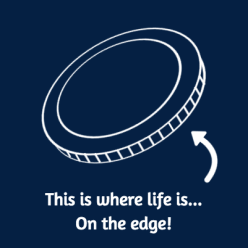 Imagine you and your brother are flipping a coin to see who gets the last dinner roll. Picking heads, you’ve predetermined that one side of the coin is success, while the other is embarrassing failure. As it floats in the sky, moving slowly through its parabolic arch, you salivate thinking about the melted butter on that last roll. And in this moment, the coin becomes kind of like Schrödinger’s cat’s coin, existing in a state of heads and tails at the same time. Both success and failure.
 This is just like the prototype that we want to test with our early adopters. Every prototype (no matter how ugly, how duct-taped together, or how functionality barren) has a chance of success. You’re setting your success metrics early and you know if you epically fail, at least you’re failing forward and learning. You let your prototypes live on the edge of the coin, why not you?
 Everyone has heard a tale or two of people with diverse, opposite appearances. The Frog Prince and the Beast can change form with true love, Dr. Jekyll and Mr. Hyde serve as faceted personalities of the same man, and Hulk smash when Dr. Banner gets mad. While the characters’ appearances serve as moral backgrounds for allegories and folk lore, there is a lesson to be learned here for innovators.



 Go Forth And Be Awesome