Being Awesome, Going Forth, Grit, Motivation

The Three-Sided Coin

SPOILER ALERT: All coins have three sides.

I learned something that I already knew but never knew when I read the book, “Make the Big Time Where You Are“, by legendary football coach, Frosty Westering. He called attention to the often-overlooked, magical third side of any and all coins.

A coin is nothing more than a squashed cylinder. It has two circular faces we call heads and tails, but it also has some thickness that becomes the third side. THE EDGE! Coach Westering would use the analogy of the coin to explain how the edge is used to go from “doing your best” to “being the best”, but we’re going to borrow it for a slightly different purpose.

Screen Shot 2015-11-30 at 9.36.41 PMImagine you and your brother are flipping a coin to see who gets the last dinner roll. Picking heads, you’ve predetermined that one side of the coin is success, while the other is embarrassing failure. As it floats in the sky, moving slowly through its parabolic arch, you salivate thinking about the melted butter on that last roll. And in this moment, the coin becomes kind of like Schrödinger’s cat’s coin, existing in a state of heads and tails at the same time. Both success and failure.

But let’s remove more variables here and not flip the coin in the air. You and your brother decide to stand the coin on its edge, and when it falls, whomever’s side is up, they get the roll.

The coin balances on its edge like an Olympic gymnast on the balance beam, and it sits. Here we are, like with the coin flying through the air, perched between success and failure, and it all rests on the edge.

There are all kinds of things you can do when the coin is resting on the edge to encourage it to fall your way. You could blow on it, tap the table, try to create some distinct movement in your favor. But why?

When the coin is on its edge, there is still a chance for victory.

Life, my friends, is a coin on the edge. You are constantly between success and failure everyday and the worst thing we can do is sit idly by and watch others take our dinner rolls.

Well not today buster. 

learnThis is just like the prototype that we want to test with our early adopters. Every prototype (no matter how ugly, how duct-taped together, or how functionality barren) has a chance of success. You’re setting your success metrics early and you know if you epically fail, at least you’re failing forward and learning. You let your prototypes live on the edge of the coin, why not you?

If you felt you had control over your success, wouldn’t you tap the table, scoot your chair, do anything you could to create enough movement to have the coin fall in your favor? Yes you would. So stop feeling like success or failure is written in the stars, or the deal of a deck of cards. Life is a coin on the edge, and you have to power to make it fall your way.

Go forth and be edgy!

Being Awesome, Buy In, Going Forth, Ideation, Innovation Mindsets, Lenses

Two-Faced Prototypes

prettyEveryone has heard a tale or two of people with diverse, opposite appearances. The Frog Prince and the Beast can change form with true love, Dr. Jekyll and Mr. Hyde serve as faceted personalities of the same man, and Hulk smash when Dr. Banner gets mad. While the characters’ appearances serve as moral backgrounds for allegories and folk lore, there is a lesson to be learned here for innovators.

We’ve talked before about how prototyping should focus solely on the verifiable hypothesis.  And we’re not backing down from this stance. You should be out there making the “ugly” prototypes quickly to learn and iterate with your customers. However, is there value to a “pretty” version? A benefit from a Dr. Jekyll over a prototype Mr. Hyde?

You bet there is! If there wasn’t, this would be a boring post. “Nope no benefit. Just thought I’d throw that out there. Thank you and goodnight.” The benefit comes when you need to generate some buy in. You’ll have one version for testing and one for pitching.

Just like any good salesman, marketer, or presenter will tell you, you have to know your audience. When you are prototyping, your audience is there to give you feedback on functionality. When you are trying to generate buy in, your audience is there to judge, question, and poke holes in your idea. And I mean that in all the best possible ways. You are asking for their commitment to your idea so they need to be able to feel as comfortable as they can with it. They have their own set of lenses that they view this trough. Mostly the “Am I impressed enough to lend support or resources to this?” lens.

You need a pretty and shiny version to create a wow moment.

Generating buy in means that you are asking people to jump aboard your ship after it has already set sail. If they are sitting on the dock looking at your wireframes or paper prototypes, it may be hard to convince them to jump. This past weekend I saw part of a quick and dirty boat building competition and I can say that there were a few “boats” that I would wave to safely from the dock. These were literally prototype boats that were testing out new ideas by people who had minimal skill in sailing, and only some entry-level life experience in buoyancy.

You want people to jump on your boat? You have to make your boat a more attractive place to be than the dock.

This is why you build the Dr. Jekyll version of your solution. The classy and marketable iteration. While it may be tempting to throw all kinds of features and version 5 ideas on to it, I would caution against them. Stick with your validated functions, the stuff that has been user tested, analyzed, and solidified. You are taking large risks showing features that haven’t been tested yet because you haven’t proven that the customer wants or will use them. This could lead to a difficult conversation to have with a backer who was sold because of this shiny future feature. Don’t stray from validated mechanics.

Even if you don’t have the time or the resources to get it to the minimum marketable version (the smallest group of validated features with an appropriate user experience that can be sold) a prettier-than-prototype version can serve you well. You can find ways to “Wizard of Oz” your prettier-than-prototype version that makes it feel real. It is more like a mock-up, a scale model, an artist’s representation of awesome.

So when you need to generate some buy in, know your audience and encourage them to come aboard with Dr. Jekyll’s shiny schooner. No one is jumping on a cardboard clipper with Mr. Hyde.

Being Awesome, Brainstorming, Ideation, Innovation, Innovation Mindsets, Lenses

Use New Lenses to See Past the Hammers

I mean really, what else could Geppetto have done?

He wanted and son so he looked around at the resources he had. Lathes, chisels, hammers, and wood. Geppetto leaned on his strengths to carve Pinocchio who would magically transform from wooden marionette to a real boy. You know, after he was done goofing off and finding his way.

Abraham Maslow said “I suppose it is tempting, if the only tool you have is a hammer, to treat everything as if it were a nail.” That’s exactly what Geppetto did. He literally had hammers and built his “son” out of wood, a material he had decades of experience with but would require magical intervention to achieve his goal.

We often fall into the same trap as innovators. We apply the same thoughts to distinct and unique problems and we murmur befuddlement when our solutions look like solutions we had in the past for a different problem.

Well murmur no more! You just need more in your toolbox than hammers.

One of the best suppliers of new “tools” is the concept of lenses for brainstorming. Lenses have the ability to be an endless and infinite supply of inspiration… and you already know how to use them! The problem is that you and I default to the same lenses. Our default lenses are the place that we work, the go to inspiration we surround ourselves with. To apply new lenses, we need to think outside our comfort zone… we need to venture into problem adjacent areas.

Let’s say we’re working on solving a certain problem. To apply and adjacent lens, we need to whittle the problem down into its barebones mechanics. “Customers do this, they need it to do this, they feel this way” and so on. This is a great time to apply the five why method to get to the root mechanics. We’ll talk about that later but for now just think of it as an over-inquisitve toddler that just wont stop.

“I need to go to the store.” “Why?”

“Because we need food.” “Why?”

“Because without food we’ll go hungry.” “Why?”

You get the point. But take a look at what those three why’s did. Instead of the problem being “I need to go to the store”, the problem is boiled down to “we need food or we’ll go hungry”. That boiled down problem is more at the root and offers way more solution possibilities.

From the base mechanics of the problem, we need to venture into other solutions that exist for the base mechanic outside our given industry. You are looking for bright spot solutions outside your realm of dominance. Work in food service? Maybe you solution lies in the way health care solved a similar problem. The world is ripe with adjacent lenses. All you have to do is ask yourself “How would X solve this?” or “How did Y eliminate this problem?” Start there and start extrapolating ideas and making connections to your own industry.

Had Geppetto thought of using lenses, he might of said to himself “You know, I’d really like a son of my own. I wonder how the farmers solve the problem of wanting children?” He might not have started with a carved marionette.

And let’s face, we cant afford to wait for our solutions to magically solve the problem. We are the magic so get out there and make your awesomeness real!

EXTRA SPECIAL BONUS!!

As an added bonus, here are a couple other lenses I like to use during brainstorming.

  • How would I never solve this problem?
  • What is the worst way I can solve this problem?

Despite it being fun to think of anti-solutions, you’ll be surprised at how effective these are at finding hidden solutions!

Being Awesome, Going Forth, Innovation, Innovation Mindsets, Lean, Lenses

Charging Up the Wrong Hill

I was enjoying a morning run while listening to an excellent game design podcast, Ludology. In episode 113, Geoff Engelstein discussed the Sunk Cost Fallacy. It works like this:

You’ve played a boardgame for a little while with your friends when you realize no one is having any fun. You turn to your friends and say “Well, we’ve gone this far lads. Might as well see it to the end.” Then you proceed to spend an evening trudging through a less-than-enjoyable experience, just because you did not want to waste the time you had already sunk into it. Instead of stopping after wasting one hour on something, you decide to spend another hour on it just to finish it, essentially spending twice as much for no reward.

It seems silly here, but it happens often in innovation.

Ed Catmull uses a model of two hills in his book, Creativity, Inc.

“People need to be wrong as fast as they can. In a battle, if you’re faced with two hills and you’re unsure which one to attack, the right course of action is to hurry up and choose. If you find out it’s the wrong hill, turn around and attack the other one.” – Ed Catmull

He goes on to say that the only wrong attack, is to go between the hills. The Sunk Cost Fallacy would have your squad start attacking one hill, realize the enemy is on the other hill, but continue to charge up this hill because they already made it part of the way up. “We don’t want to waste that initial charge, sarge.”

The Sunk Cost Fallacy is the enemy to innovation. To understand how to defeat it, well use the Lean Startup principle, the Build-Measure-Learn feedback loop, as a lens.

Build

This is the phase that lets you minimize your sunk cost. Keeping costs low helps you mitigate the opportunities for you to say “We’ve spent so much already on this… we should push forward.” A great way to minimize sunk cost is to prototype as minimally as possible. What are you testing? What’s the cheapest way to validate it? Maybe there is a way to build a Paper Prototype or to smokescreen your prototype? Do not splurge on additional features, functionality, or looks. You just need what is minimally viable.

Measure

Numbers never lie, but we tend to bend their truths from time to time. Set the success metrics for your prototype as early as you can. Do not budge on these numbers and be honest with yourself. If you set a goal of a 5% conversion rate, your test may be successful, but are you really reaching for where you need to go? Be wary of vanity metrics. Focus on the stuff that is going to matter.

For a great model of this, look to baseball and the rise of Sabermetrics. Some statistics are easy to calculate in baseball; like batting average or earned runs average. However, some people started to look at new statistics, ones that really highlighted the value of the player towards creating a winning team. Sabermetrics includes stats like runs created or wins above replacement. You need to find the mechanic or action that your prototype needs to accomplish now, and build a statistic tied directly to that, in its most simplistic form.

Learn

Charging up the wrong hill is ok, as long as when you realize it is the wrong hill, you don't keep charging up because that's what you've always done. Time to find the next hill.
Charging up the wrong hill is ok, as long as when you realize it is the wrong hill, you don’t keep charging up because that’s what you’ve always done. Time to find the next hill.

At this point you’ve tested your prototype, collected your success metric data, and your hypothesis has either succeeded (in which case, ignore me) or it has failed (read on, dear reader!). This is the exciting part. You’ve proven, with numbers, that you’ve charged up the wrong hill and it is time to face facts. Now you get to pivot! This might mean you need to spend more time understanding and building empathy for your customer. This might mean you need to evaluate the constraints of your test. Perhaps your solution has driven too far from the problem. There is a world of opportunity and learning at a pivot point… AS LONG AS YOU DONT KEEP CHARGING UP THE HILL!

But I mean, why would you? You kept your costs low by building a minimally functioning prototype, you set your success metrics early, and you failed/learned. This is a great moment! Celebrate as you get out your tactical map, cross the hill off with a red marker, and proclaim “Time to charge up that other hill!”

Challenge

Has there ever been a time when you charged up a hill even after you new it was the wrong hill?

How did the second half of that charge feel?

What are ways to minimize your sunk cost?

Being Awesome, Innovation, Innovation Mindsets, Like a Startup, Motivation, Team

How In-N-Out Burger Became My Innovation Anchor

What started as an impassioned plea to a team amidst a sea of chaos in a busy In-N-Out burger has become a rallying cry in the innovative process.
What started as an impassioned plea to a team amidst a sea of chaos in a busy In-N-Out burger, has become a rallying cry in the innovative process.

In the Spring of 2014, I traveled to San Francisco with some friends for a conference. I was raised on the West Coast, so any trip to California results in a required pilgrimage to In-N-Out Burger. It was a busy night at the closest In-N-Out and the dining area was packed with like-minded culinary aficionados.

We waited eagerly for our orders at the counter when you could feel the energy change. There were very loud “conversations” happening on the staff side of the counter. I couldn’t make out words but it was definitely heated from the chaos of the dinner rush. And that’s when our hero stepped in. He came from a spot in the back where he had been working the large, manual french fry cutter. He raised his eyes from the floor with the same erie calm that rolls over a seaside town before a hurricane strikes. Then we heard him proclaim, in all of our sight, a statement that’d change our mindset that night.

“We’re all… on the same… level.”

It is devious in its simplicity. This was not a time for hierarchical org charts or chains of command. Every employee there was tasked to get orders in, and then out. In and out. It was not about pulling rank or telling others how to do their job better. Get the orders in, and then get them out.

That simple statement has anchored the better part of a year and a half of innovation theory development. It has become a mantra, a safe harbor, and a compass. Here are the two best applications of “We’re all on the same level.”

1. Your team is all on the same level.

Hopefully you’ve had the opportunity to read my post on T-Shaped teammates and flat teams. If you haven’t it is located here.

Having a flat team has many benefits, specifically in the deployment of candor. Without a designated manager or leader, each person feels comfortable offering up bad ideas as well as critical feedback on other prototypes. Open dialogue helps the team move faster towards promising solutions.

A wise person once said “A good idea doesn’t know its parent.” An individual on flat team doesn’t seek credit and instead uses any success to reflect back on the team’s efforts. Another benefit is that when tasks or events arise, everyone is willing to pitch in. There may be tasks above or below the team’s station and if they are an honest-to-goodness flat team, then there will be shared coverage of those tasks.

The team functions for collective goals when they’re all on the same level.

2. The problems you try to solve are all on the same level.

There are two main schools of thought around innovation. You either start with a solution or you start with a problem. The majority of what I do starts with a problem. It requires me to research the problem and empathize with the customer, because sometimes the problem you see is not the real problem. There are problems that seem cut and dry. Slap on a salve of solution and you are good to go. Then there are problems that look dark and wrapped in a bramble of thorns. But here’s the rub. If you have an effective process for tackling problems, then all your problems are on the same level.

The simple problem does not get a watered-down, vanilla version of your process. If your process works, apply it to the small problems.

The tricky or large problem does not get additional steps or tools applied to your existing process. If your process works, apply it to the large problems.

It minimizes to this: If you are trying to solve a problem, apply your effective process in its best and truest form.

Keeping things all the same level reduces politics and favoritism, and helps promote candor and openness. And to borrow one of Walt Disney’s famous quotes… “It all started with a burger.”

Challenge

  • Are there things that you put at different levels?
  • Would rearranging them all on the same level affect your innovative process?
  • When faced with a new problem, ask yourself “How would In-N-Out solve this?”
Being Awesome, Failure, Going Forth

A Few Inches To The Left

Driving home on the final day of high school, I fell asleep at the wheel. I awoke only a handful of instants before slamming head on into a telephone pole. Luckily, in those spare milliseconds, I was instinctively wrenched the wheel to the left even though collision was imminent. Continue reading

Being Awesome, Brainstorming, Diffusion of Innovation, Ideation, Innovation, Understanding the Customer

Innovating with the Uninterested

My kids send me strong signals all the time. For example, when we have broccoli or sweet potatoes, they respond with very strong signals. Unfortunately their signals are strong AND negative. One way we’ve tried limit these anti-veggie reactions is to get them involved in the meal planning.

Like in meal planning, we should be looking for strong signals with prototype tests. Strong signals validate that solutions are worthy of digging into deeper. Sometimes, you will get responses of “I don’t like this” or “I’m not sure this will work.” These are great strong signals, just not the ones you may have been looking for. Their value though can be immense.

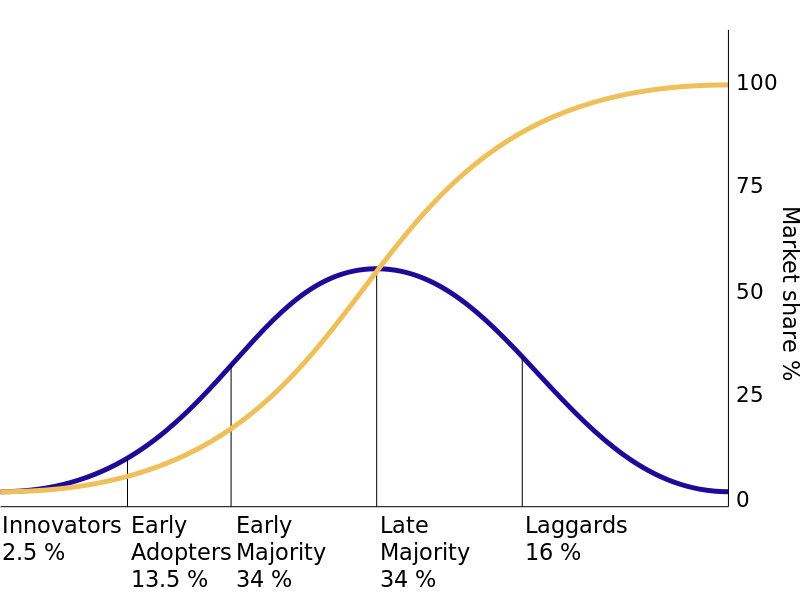
diffusionOfInnovationLooking at the Diffusion of Innovation, these types of strong signals would be achieved from folks in the “Late majority” category. That accounts for 34% of the market, and yet we design by relying on “Early Adopters” or the “Early Majority”. How can we move their timeline of adoption up? How can we use their strong signals, and their personas, to help make our prototype better?

We can design with them!

Wrangle up some of those “This will never work” naysayers and get them in an ideation session. You can often get them to agree by just being honest. No need for trickery or bribes. Just tell them that you’re sorry your one idea didn’t fit for them but you’d like to understand their view better.

“Great! Now I have all the people who hated my prototype in one room. What do I do now?”

It is simple, just understand these three guidelines.
  1. Let the customer drive the conversation
    Strong signals, like kids rebelling over the inclusion of broccoli, can indicate the presence of the "Late Majority". Instead of taking a hit to your momentum, use their energy to design a new, better solution!
    Strong signals, like kids rebelling over the inclusion of broccoli, can indicate the presence of the “Late Majority”. Instead of taking a hit to your momentum, use their energy to design a new, better solution!
    • You must aim for a 80-20 ratio of listening to talking.
    • Listen to understand, not to react.
      • This is a personal pet peeve, but too often we listen with the intent of reacting to what someone says. Especially here where you’ve already show the customer a solution. They will say “Well I need it to do X.” and you’ll want to say “Well what I showed you will already do X, you may have missed it.” AVOID THIS! Internalize that thought but come back to them with something like “Interesting. When it does X, what does that look like to you?”
    • Reiterate what they say if you are unclear.
      • Remove any uncertainty.
    • You may need to set up the ideation session with some easy wins up front to grease the gears of innovation.
  2. Keep their options limited
    • Too many options and they will freeze up. It’s a cousin of the “blank page” syndrome.
    • Constraints can also help people be creative.
      • It’s like squeezing a tube of toothpaste. Applying pressure, with the constraints of the rest of the tube, pushes the paste onto the brush.
  3. Nothing needs to be pretty
    • An “ugly” prototype or a napkin sketch keeps the customer from thinking the idea is set in stone.
    • Thinking everything is “up for change” frees them up to make more suggestions.
    • Encourage them to take a crack at some wireframes.
      • You will hear “I’m not good at drawing” but we’re not looking for art here, just ideas. You can offer to draw for them if this is a sticking point.

I’m not saying you’ll end this process with a market-capturing design. But you will have a better understanding of the needs, the pain points, and the potential gains for your innovation with the Late Majority. Imagine if you can inspire the Late Majority to adopt sooner!

Being Awesome, Ideation, Innovation

Open Your Doors Before You’re Ready

You ever have one of those ideas that floats around, just kind of dancing in your brain, eager to be released? You can coax the idea to calm down for a little while by saying “Ok, I’ll let you out, but I have to have this one thing in order first. I want you to be a success!” And so your idea calmly sits while you prepare. It’s not long afterwards that your idea gets anxious again, and you have to encourage it to calm down once more. And this cycle repeats. Why?

I’ll tell you why. We have this fear that if everything is not just right, our idea is going to fall flat on its face. We lose too much while waiting for the “right time”. However, by waiting we’re only building more anxiety that our idea must be perfect when it is released. We need to spend less time with our ideas “on the ground” and get more of our ideas soaring “in the air”.

Early adopters don't care if you're 100% ready. Get those doors open and let you idea gain some traction in the real world.
Early adopters don’t care if you’re 100% ready. Get those doors open and let you idea gain some traction in the real world.

In 1966, a shoe store opened in Anaheim, California. They saw 16 people walk in the store that first day and 12 of them made a purchase, and yet the shoe store didn’t have a single shoe in the store. They had samples of the different styles, but nothing the customers could leave with right then. Instead, the customer placed an order, the store would get to work making the shoes, and the customer could pick them up later that day.

The store only operated like this for the first couple days, but the owners simply couldn’t wait to open. The doors were flung open as soon as the store could be open, there wasn’t time to wait on actually having shoes. In fact, the shoe samples didn’t even have names. They were just design numbers like #44 or #20.

And that is how Vans started.

You see, Paul Van Doren, James Van Doren, Gordon Lee, and Serge D’Elia didn’t want to wait until everything was perfect. They wanted to get their idea out there so it could breathe and run and live.

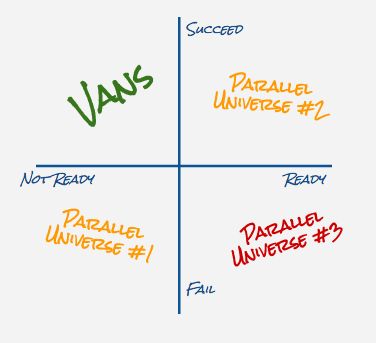
If we twist the story just a little, we begin to see the brilliance. We’ve already seen what happens if they open early and succeed, but there are three other parallel universes out there.

  • Parallel Universe #1: They open early and fail. No harm, no foul. They don’t have a surplus of shoes that they need to unload or wear for the rest of their lives. Not as bad an outcome as bad outcomes go.
  • Parallel Universe #2: They wait until they craft all their shoes and succeed. This is a boring story because there is nothing surprising about it. Nobody took a chance. This is like following the on-box directions for macaroni and cheese. No one is surprised when it comes out as macaroni and cheese. This is routine and nothing of note can be gained here. Move along.
  • Parallel Universe #3: They wait until they craft all their shoes and fail. This is the evil timeline. They lose a ton in this version of the story. Money, time, materials. Think of all the extra shoes that they can’t sell! In this universe, all their cousins and nieces and nephews are cautious around birthdays. “Uncle Paul is coming? He’s probably going to give me another pair of those shoes again.”

failvsreadygraphBy opening the doors early, they ran the best chances at success. And this will please all you managers out there, by opening early they mitigated the most risk. They had an opportunity to validate their ideas before spending resources to make the idea perfect.

That’s what we’ve got to do as innovators. We may have an idea that we’re sure will flip the market on its ear and make the world a better place to live in. But the longer it is just an idea, the more time the market has to catch up or diverge. There is nothing worse than spending years on an innovation to launch it and have the market say “This solution exists already” or “We don’t need this solution anymore because the problem has changed.”

If you need further convincing about opening your “idea doors” early, you don’t even have to leave Anaheim. Just travel back in time from Vans in 1966, to Disneyland in 1955.

As the gates opened for the first time on July 17th, Disneyland faced these problems and more:

  • some trees had just been planted
  • some of the paint was still wet
  • counterfeit tickets doubled the number of guests expected
  • water fountains didn’t work because a plumber strike meant only the bathrooms would be functional
  • the asphalt on Main Street had only been poured the night before

The myriad of challenges Walt and his team faced on Day One were used as a learning opportunity. A chance to figure out what wasn’t working. Shouldn’t we afford our ideas the same chance? The same opportunity to learn and grow from the challenges? We’re supposed to be embracing failure, so let your ideas out into the sun!

I’ll close with the words of the immortal bard, Shia LaBeouf. “Don’t let your dreams be dreams. Yesterday you said tomorrow so just do it. Make your dreams come true.”

Go forth! Be Awesome! Feed your furnace!

Challenge

  • What idea has been living in your head for too long?
  • What can you do today to get it out into the world?
  • What can you learn from sharing it with someone right now?
Being Awesome, Chupacabra, Innovation, Motivation, Theme Park of You

Be the Theme Park of YOU!

If I was to ever start a theme park, and let’s say my mascot is Chupey Chupacabra, I’d be 100% sure to offer a goofy looking Chupey Chupacabra hat. Every theme park has their own trademark-toting version of the Chupey Hat because tourists eat those kinds of things up! They will spend some hard earned cash on items they will only wear while at a theme park. Folks, this is a hat you will never wear again… yet you will wear it for the length of your vacation until a permanent indention forms on your forehead from the sweatband. You will shriek in panic if you leave it behind on a ride. You will run back to your hotel to grab it before you dinner reservation at our five-star restaurant.

But why?

You won’t wear it while shoveling snow in Pocatello, Idaho. You certainly wont wear it walking down the street in Dover, Ohio. There is a special aura that theme parks give off, especially in their merchandise. So what makes theme parks such a hot bed for impulse fashion decisions?

For only $19.99, you too can wear the Chupey Chupacabra Hat all around the theme park. You'd never wear this at home, but in this theme park it is enchanting!
For only $19.99, you too can wear the Chupey Chupacabra Hat all around the theme park. You’d never wear this at home, but in this theme park it is enchanting!
  • For starters, they are telling a story that tourists can get into. Tourists are allowed to have fun, believe, and pretend.
  • Also, there is great power in being surrounded by like-minded others.
  • Lastly, everything the tourists are experiencing enhances and pushes the story further. The theme park supports and enables the Chupey Hat culture.

We need to capture this for ourselves! We need to tell stories about us that others can get behind. We need to give people are reason to believe in our ideas, our innovations, our plans for the future. We need to foster the culture around us so that our supporters aren’t one or two individuals, but rather a massive crowd gathered to watch a parade and maybe some fireworks later. And because they’ve gathered, we need to show that we can drive the story, ideas, innovations further. We are going to reward and support those who carry our banner.

And yet, when tourists go home, they put their Chupey Hats and other souvenirs away. So how can we lengthen the effects of their Chupey Hat? How can we recreate the excitement of our rollercoasters of innovation?

There are two paths: We can give them a take-home version, or we can encourage and enable repeat visits.

  • Take-home versions are compact, often watered down, and don’t affect their worldview. At best, take-home versions are distractions to their daily life, if they have time. They will most likely be put in a box in the garage and then reminisced over when they are told to clean the garage because we can’t park a car in this mess.
    • This path is not effective, yet. I think it could be reinvented to be more optimal.
  • Repeat visits encourages them to take care of their Chupey Hat. It deepens the hold the story has within their heart and mind. Someone who visits repeatedly is more likely to have memorabilia all over their house. They are planning a return visit to the theme park of you before their current visit is over. They are probably stock holders; they are invested in your success.
    • This is the good path!

As I am writing this, I can identify who wears the Chupey Hats in the theme park of me. They are amazing people and I’m honored that they even visit much less be such adamant supporters. However I can not rest on my laurels. I have to add new rides, I have to give them better experiences. I’ve got to expand and develop the Chupey Chupacabra storyline because these tourists are the early adopters. And what they’ve early-adopted was a belief in me.

Challenge

  • What is the main story in the theme park of you?
  • What kind of merchandise can we get in the theme park of you?
  • How are you going to make tourists want to come back?
Being Awesome, Innovation, Innovation Mindsets, Lenses

Paint the Fence as a Beginner

Daniel didn't balk at starting his own bonsai tree when Mr. Miyagi offered. Even though he was a beginner, the vision for the tree still lived in his mind.
Daniel didn’t balk at starting his own bonsai tree when Mr. Miyagi offered. Even though he was a beginner, the vision for the tree still lived in his mind.

The 1984 Columbia Pictures classic, Karate Kid, obscures an awesome tidbit that I had not caught before this week. The movie glosses over quickly the fact that Mr. Miyagi had never taught anyone karate. Not until Daniel needed to learn that the secret to karate is in the heart and mind, not in the hands. This is the movie’s most memorable character arcs, as Daniel learns karate while sanding the deck, waxing the cars, and painting the fence.

Mr. Miyagi does not have years of proven methods to train Daniel with. No, he thinks outside the box to give Daniel hours of practice developing strength and muscle memory. That’s because Mr. Miyagi, whether he knew it or not, was employing shoshin (the beginner’s mind).

The beginner’s mind is something we need to embrace as well. No matter if we are trying to convince an innovation from the caves of our minds to bask in the light of day, or if we are just looking to go forth and be awesome.

Try taking on a new skill and expanding what you can do. Broaden your T-shaped self. By venturing into new territory, you activate your student mindset. You look at items with fresh eyes. You are unburdened with years of “this is how we’ve always done it”. Of course those first few steps in your chosen new skill are awkward and unstable. But you get to revel in the fact that this is part of the learning process!

“Dude, suckin’ at somethin’ is the first step towards bein’ sorta good at somethin’.” – Jake the Dog, Adventure Time

Thinking differently is at the root of innovation. It happens in multiple ways. The traditional way is when someone gets so upset with the status quo that their thoughts break the boundaries of the typical box. They start to think of how everything can be better. These are the heretics that go against the rules. (Heretic in this sense meaning someone who goes against what is generally accepted)

Another road to innovation is when the tide of shoshin rises. Seeing things as a beginner means you don’t shy away from the boundaries. In fact you push on them to see if they give. This often leads beginners to solutions experts can’t see. Experts are weighed down by proven paths to success. To a beginner, all paths are viable from where they stand… so why not try a few?

So engage your shoshin, be a beginner at something. Then start applying that new viewpoint to your innovation. Who knows what solutions you’ll uncover?

Challenge:

  • What skill would help your innovation move forward?
  • What can you do to start learning that skill?
  • Early in your learning, look at your solution again. Are there new hypotheses to validate?