Being Awesome, Chupacabra, Innovation, Motivation, Theme Park of You

Be the Theme Park of YOU!

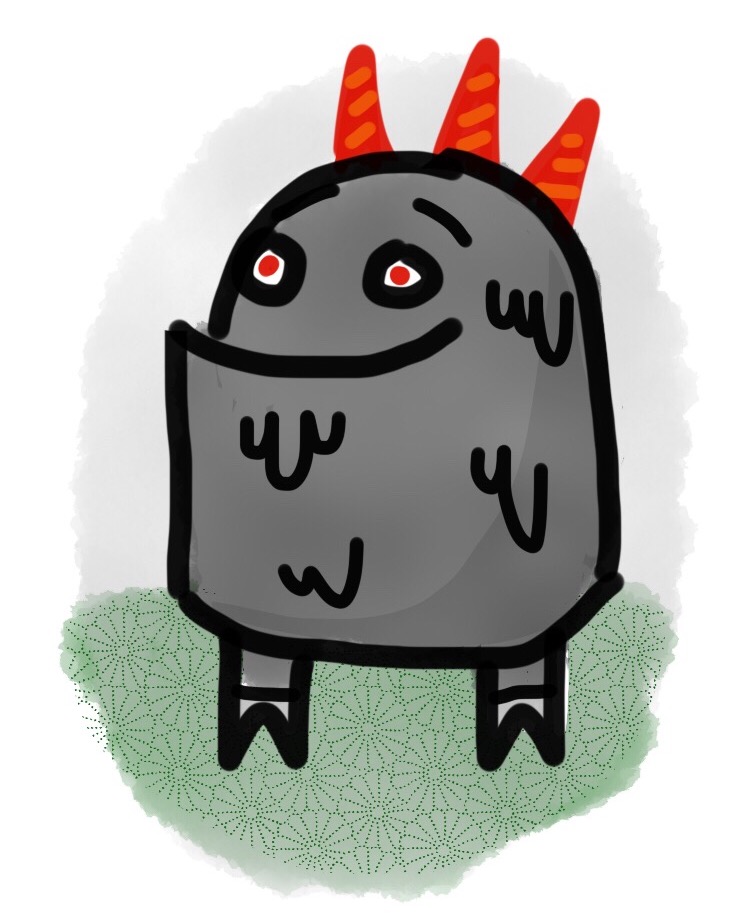
If I was to ever start a theme park, and let’s say my mascot is Chupey Chupacabra, I’d be 100% sure to offer a goofy looking Chupey Chupacabra hat. Every theme park has their own trademark-toting version of the Chupey Hat because tourists eat those kinds of things up! They will spend some hard earned cash on items they will only wear while at a theme park. Folks, this is a hat you will never wear again… yet you will wear it for the length of your vacation until a permanent indention forms on your forehead from the sweatband. You will shriek in panic if you leave it behind on a ride. You will run back to your hotel to grab it before you dinner reservation at our five-star restaurant.

But why?

You won’t wear it while shoveling snow in Pocatello, Idaho. You certainly wont wear it walking down the street in Dover, Ohio. There is a special aura that theme parks give off, especially in their merchandise. So what makes theme parks such a hot bed for impulse fashion decisions?

For only $19.99, you too can wear the Chupey Chupacabra Hat all around the theme park. You'd never wear this at home, but in this theme park it is enchanting!
For only $19.99, you too can wear the Chupey Chupacabra Hat all around the theme park. You’d never wear this at home, but in this theme park it is enchanting!
  • For starters, they are telling a story that tourists can get into. Tourists are allowed to have fun, believe, and pretend.
  • Also, there is great power in being surrounded by like-minded others.
  • Lastly, everything the tourists are experiencing enhances and pushes the story further. The theme park supports and enables the Chupey Hat culture.

We need to capture this for ourselves! We need to tell stories about us that others can get behind. We need to give people are reason to believe in our ideas, our innovations, our plans for the future. We need to foster the culture around us so that our supporters aren’t one or two individuals, but rather a massive crowd gathered to watch a parade and maybe some fireworks later. And because they’ve gathered, we need to show that we can drive the story, ideas, innovations further. We are going to reward and support those who carry our banner.

And yet, when tourists go home, they put their Chupey Hats and other souvenirs away. So how can we lengthen the effects of their Chupey Hat? How can we recreate the excitement of our rollercoasters of innovation?

There are two paths: We can give them a take-home version, or we can encourage and enable repeat visits.

  • Take-home versions are compact, often watered down, and don’t affect their worldview. At best, take-home versions are distractions to their daily life, if they have time. They will most likely be put in a box in the garage and then reminisced over when they are told to clean the garage because we can’t park a car in this mess.
    • This path is not effective, yet. I think it could be reinvented to be more optimal.
  • Repeat visits encourages them to take care of their Chupey Hat. It deepens the hold the story has within their heart and mind. Someone who visits repeatedly is more likely to have memorabilia all over their house. They are planning a return visit to the theme park of you before their current visit is over. They are probably stock holders; they are invested in your success.
    • This is the good path!

As I am writing this, I can identify who wears the Chupey Hats in the theme park of me. They are amazing people and I’m honored that they even visit much less be such adamant supporters. However I can not rest on my laurels. I have to add new rides, I have to give them better experiences. I’ve got to expand and develop the Chupey Chupacabra storyline because these tourists are the early adopters. And what they’ve early-adopted was a belief in me.

Challenge

  • What is the main story in the theme park of you?
  • What kind of merchandise can we get in the theme park of you?
  • How are you going to make tourists want to come back?
Being Awesome, Innovation, Innovation Mindsets, Lenses

Paint the Fence as a Beginner

Daniel didn't balk at starting his own bonsai tree when Mr. Miyagi offered. Even though he was a beginner, the vision for the tree still lived in his mind.
Daniel didn’t balk at starting his own bonsai tree when Mr. Miyagi offered. Even though he was a beginner, the vision for the tree still lived in his mind.

The 1984 Columbia Pictures classic, Karate Kid, obscures an awesome tidbit that I had not caught before this week. The movie glosses over quickly the fact that Mr. Miyagi had never taught anyone karate. Not until Daniel needed to learn that the secret to karate is in the heart and mind, not in the hands. This is the movie’s most memorable character arcs, as Daniel learns karate while sanding the deck, waxing the cars, and painting the fence.

Mr. Miyagi does not have years of proven methods to train Daniel with. No, he thinks outside the box to give Daniel hours of practice developing strength and muscle memory. That’s because Mr. Miyagi, whether he knew it or not, was employing shoshin (the beginner’s mind).

The beginner’s mind is something we need to embrace as well. No matter if we are trying to convince an innovation from the caves of our minds to bask in the light of day, or if we are just looking to go forth and be awesome.

Try taking on a new skill and expanding what you can do. Broaden your T-shaped self. By venturing into new territory, you activate your student mindset. You look at items with fresh eyes. You are unburdened with years of “this is how we’ve always done it”. Of course those first few steps in your chosen new skill are awkward and unstable. But you get to revel in the fact that this is part of the learning process!

“Dude, suckin’ at somethin’ is the first step towards bein’ sorta good at somethin’.” – Jake the Dog, Adventure Time

Thinking differently is at the root of innovation. It happens in multiple ways. The traditional way is when someone gets so upset with the status quo that their thoughts break the boundaries of the typical box. They start to think of how everything can be better. These are the heretics that go against the rules. (Heretic in this sense meaning someone who goes against what is generally accepted)

Another road to innovation is when the tide of shoshin rises. Seeing things as a beginner means you don’t shy away from the boundaries. In fact you push on them to see if they give. This often leads beginners to solutions experts can’t see. Experts are weighed down by proven paths to success. To a beginner, all paths are viable from where they stand… so why not try a few?

So engage your shoshin, be a beginner at something. Then start applying that new viewpoint to your innovation. Who knows what solutions you’ll uncover?

Challenge:

  • What skill would help your innovation move forward?
  • What can you do to start learning that skill?
  • Early in your learning, look at your solution again. Are there new hypotheses to validate?
Being Awesome, Innovation

Status Quo Dies Hard: With a Vengeance

Cool guys don't look at explosions, or validated hypotheses from minimum viable prototypes.
Cool guys don’t look at explosions, or validated hypotheses from minimum viable prototypes.

The clock ticks down… 00:07, 00:06, our hero grabs the secret briefcase and kicks the evil mastermind sprawling to the floor. 00:04, 00:03. “Seems like you forgot to study the map with the escape routes!” the villain cackles. Our hero runs towards the walls of the mountain-top base and looks hundreds of feet down the cliffs to the ground. “I don’t need to study” he says while looking back at the villain. 00:01 “I’ve got the cliff notes.” 00:00 He leaps over the wall, his tuxedo transforming into a paraglider as he is silhouetted by the massive explosion behind him.

Whew! What a cliffhanger! (See what I did there?) Action adventure stories can leave us with a rush of excitement and adrenaline, whether they are movies or books. This past week I was able to attend a local meet-up of writers. The topic of the day was action adventure heroes and plot structure. It was an excellent discussion but my mind kept coming back to innovation.

For example, in action adventure stories, there are good guys and there are bad guys. It is a clean division of Team Yay and Team Boo. The hero, solidly in the Team Yay category, doesn’t wan’t to understand the bad guys. He wants to defeat and eliminate them. The story usually takes place in a unique location that the hero is not one-hundred percent comfortable; it is not his home turf.

At this point, a light went off in my head. Take those points about the hero in action adventure stories and portray it as someone against innovation. There are clear distinctions between what they support (this is Team Yay because it isn’t risky) and what they don’t support (this stuff is Team Boo because it scares me). Our anti-innovation “hero” wants to defeat and eliminate the risky items on Team Boo. And in fact, this usually occurs when data or trends are suggesting that change is happening around them, making the market hostile to this person.

So many parallels. And then this brain-bolt struck.

In an action adventure story the protagonist doesn’t grow as a person over the course of the movie/novel. There is no realization that a different solution may work. Rambo never wants to talk it out. James Bond never invites a woman over to just watch Netflix. Indiana Jones never seeks therapy to overcome his fear of snakes. (I think its connected to early childhood trauma from taking his dog’s name as his own)

Action heroes are a metaphor for the fight against change. They are a protector of reader’s/watcher’s mental status quo.

“Life is too short to fight the forces of change. Life is too short to hate what you do all day.Life is too short to make mediocre stuff.” Seth Godin, Tribes

So just remember that to some, we innovators are seen as the bad guys. We challenge their worldview, we smash the status quo, we trod down paths that don’t exist yet. Our task is to take out-of-the-box ideas and pitch them in-the-box. And sure, these action heroes may be laggards when it comes to adoption, but think of all the learning that is to be had by observing and developing empathy for their point of view!

Challenge

  • Identify someone that has been the action adventure hero to your innovation.
  • Gain empathy for their views by observing what they say and do.
  • Talk to them one-on-one and discover their thoughts and feelings around your innovation.
  • Use those four points of empathy (think, say, feel, do) to look at your innovation a new way.
  • BONUS: Get them to champion your innovation!
Being Awesome, Innovation, Team

How many C’s are there in “Innovation”?

Being part of a good innovative team is a dream. It is mutually rewarding, there are no stepped on toes or bruised egos, and everyone helps elevate each other’s ideas and projects to that “OMG wait until the world sees what were doing!” level. However, not all teams are created the same, and some are clearly created just to put sand in your sunscreen. I’ve identified four attributes that can help your innovation team reach new heights and upgrade into a traction-churning prototype machine!

Change

Making change sounds intuitive when working in innovation, but “change” is not just a product your team produces. Your team must embody change in order to stay relevant, effective, and productive. An innovative team that is set in their ways is like a brand new car in neutral; flashy and shiny now but ultimately going nowhere.

Change exists in your team procedures. There is no set template for innovation and what works today may not work tomorrow. Since variables and climates shift constantly, each problem you set out to solve needs to be evaluated for appropriate procedures for you and your team. Surveys and A/B testing of prototypes may have helped you understand your wireframes, but will those procedures help you learn about functionality?

Change exists in your team skills. Previously, we’ve talked about being T-shaped. If you are T-shaped, then your horizontal skills are where the change is going to be most noticeable. Those are the skills that possibly overlap with teammates, but are needed to fill in production gaps. Similarly, based on your proposed solutions that you need to prototype, you and your team may need to stretch beyond your skill sets into unknown territory. Sure, there are vendors out there that are experts in what you need to accomplish but they cost money. If you’re in the prototyping stage, you will need to weigh whether you can learn enough to create a testable prototype or if you need to spend the money. Either way, you should start learning about what you need, even if you chose to outsource work with a vendor. It makes communication easier if you have a basic understanding.

Candor

This can often be the hardest one for a team to develop because we want to encourage everyone. Yet not every idea, prototype, or hypothesis is a world-changing gem. Sometimes they’re just bland blobs of meh. That’s ok. You can still praise effort without agreeing with an idea. Try to level up the mediocre hypotheses and raise up your teammates. However, and I can not stress this enough, DO NOT LET THEM MOVE FORWARD WITH A STANDARD IDEA. You are doing them a disservice by not forcing them to make the idea better. You are passively undermining your whole innovation team. Likewise, you should prepare yourself for the time when your team will say your idea is “average” or worse. Candor is a two-way street. I am lucky that my team has saved me from shipping mediocre ideas. The best way you can show true respect for each other, is to demand each other’s best effort everyday.

“Life is way too short to make mediocre stuff. And almost everything that is “standard” now is viewed as mediocre.” – Seth Godin, Tribes

Credit

Innovation is lantern and unfiltered it can burn as bright as the sun. Nothing diminishes that light more than personal plans to receive recognition. In an innovative team, a team full of T-shaped dynamos, there is no room for ego and personal glory. When someone wins, it is because of the team. Just like a apple tree can not point to one rain storm as the reason it grew, your ideas are the product of the fertile soil in your brain and the collective brainstorms of your team in the past, event he unrelated ones. It is a bit cliche to say “There is no I in team” and it is quite futile because there are plenty of joke responses that defuse the power of the statement. However a team that is concerned about getting credit for individual contributions, wont contribute to the global good.

One great way to defuse this is to constantly recognize others for their contributions to your individual and team’s work. If people are constantly feeling appreciated for their efforts, then they won’t feel the need to find more recognition. It’s one of those “Do unto others” things. Plus, it’s just plain nice to do! Especially since you are working on an innovative team. Some projects you will lead and pilot. Others will find you following and pushing the project to gain momentum. And yet other projects will find you on the sidelines, cheering and consulting when you can. Team first, in every role.

Chupacabras

The Chupacabra of Innovation!

You need to allow the odd, the unique, the unbelievable, and the silly to integrate with your team. Hopefully your team of innovators is a group of positive deviants; bristling with energy to make a good change in the world. Chances are that the team has some ideas that are “out there”. They must be allowed to exist. Maybe an idea can be so wild that you won’t do it, but talking about it can spur the conversation down avenues you would have never considered before. One of our favorite brainstorming questions is “What would our industry NEVER do?”. We dance on the undiscovered edges of the maps, the parts where the dragons are supposed to live. We need to be the explorers of the fringe, the cultivators of the odd thoughts. That’s how we disrupt the market’s standard flow.

Challenge

  • When was the last time someone on your team said “This is how we always do it”?
  • What’s the most minimal way you can start to incorporate kaizen into your procedures?
  • A great way to start getting candor flowing is to be the first target. Put an idea out there and push your team to tear it apart. Have them find ways that it will fail. 
  • How can you incorporate a team-only view of recognition?
  • At your next brainstorming, challenge the team to come up with the worst ideas or the silliest ideas. 
Failure, Going Forth, Lean, Learning

Making the Fear of Failure Disappear

While learning powerful, mathemagical incantations, I feared failure more than any dragon.

When I was a young mathematics apprentice, learning at the feet of some true numerical wizards, I feared the scarlet letter F would be burned into my forehead like many before me. F for Failure. My grades were good, my test scores were solid, and I picked up topics quickly. Yet I clung to my homework, afraid to turn it in. I would make up excuses like “I forgot it” or “I misplaced it” but the truth was I feared failure.

Chances are, many of you were like me. It may not have been math, but there was some Zone of Fear that dampened your growth in some area. I was bold and not afraid in other areas of my life, but math had my number. (See what I did there?) What I should have done was apply what I learned from my dad on the football field, and applied it to math class. He taught me to “Try your best, you will be glad you did.

Somewhere in our brains, we don’t ever want to be proven wrong. We balk and drag our feet when new, daring opportunities arise. We would like things to be nice and manageable so that we can be successful. Dr. Carol Dweck wrote an amazing book on this called Mindset: The New Psychology of Success. She identifies this behavior as the Fixed Mindset. Failure means I’m not good enough, that I am dumb and out of my league. Dr. Dweck goes on to explain the Growth Mindset as one that feeds off the challenge, isn’t afraid of failure because that’s when the most learning and growth happens.

“The secret to being wrong isn’t to avoid being wrong! The secret is being willing to be wrong. The secret is realizing that wrong isn’t fatal.” – Seth Godin, Linchpin

The Growth Mindset philosophy blends nicely with strong trends in the startup culture. In startups, and really all innovation, we are supposed to develop quick, minimally viable prototypes to test. You put your innovative hypothesis out there and see if it fails. In fact, I’ve come to love the failures with prototypes more that the successes. Failures give you so much insight into what is and isn’t working, while successes only cast doubt that your idea isn’t innovative enough.

“This is one of the most important lessons of the scientific method: if you cannot fail, you cannot learn.” Eric Reis, The Lean Startup

Losing your fear of failure will feel awkward initially. That first time you tell yourself “Self, it’s ok that I failed because if I don’t know something, it is a chance to learn.” After a short while though, it starts to become second nature. You will start pushing your innovations further. You will beg and plead with the startup muses for a good failure. Not only will you gain valuable learning and find the proverbial “10,000 ways it doesn’t work”, you will also be able to feed those failures to your furnace.

“But I keep cruising. Can’t stop, won’t stop moving. It’s like I got this music, in my mind saying, ‘It’s gonna be alright.'” Taylor Swift, Shake It Off

I was able to overcome my fear of failure in math, and in my innovation work I embrace failure as an old, wise friend. So today is the day that you too start eating failure for breakfast. Shift your brain into a Growth Mindset high gear. Because even if you fail to lose your fear of failure today, you’ll learn a better way to try again tomorrow. Now go forth and be awesome!

Challenge

  • When was a time that fear of failure stopped you from going forth?
  • Last time you failed, what did you learn?
  • How can those lessons help you find a better way for the next iteration?
Being Awesome, Going Forth, Innovation, Motivation

Feed the Furnace

On a foggy night, he started his run 95 minutes behind schedule. He was determined to never arrive late vowing to “get there at the advertised time”. Illinois Central’s engineer had the tough task of making up over an hour and a half between Memphis and Canton. The engineer’s name was Jonathan Jones, but he went by Casey.

Casey Jones feeding his furnace.

Casey Jones’s heroic tales were reimagined in the 1950 Walt Disney Studios animated short, The Brave Engineer. In the cartoon, Casey Jones at one point jumps onto the front of the train to save a woman from the tracks. This was based on a true story where real-life Casey rescued a child in the same manner. Perched precariously on the cow catcher, his outstretched arms would scoop up the child who was frozen in fear on the tracks. Another exploit of animated Casey shows him ripping every part of his train down, from the cab to the caboose, and throwing it into the furnace of the locomotive… all in an effort to arrive on time.

We all have our own furnace inside of us. It powers our drive and brings our motivation to a boil. We do not have the convenience of a coal car that carries our fuel with us and Casey Jones had to tear down his own baggage car to get more out of his furnace. What can we do?

At the center of the furnace is a fire and fires in their own right are pretty great. You can build a camp fire and it will bring you warmth and light. If your fire is strong enough, others can gather around your fire. Go check out FAKEGRIMLOCK’s post about being on fire at FeldThoughts. The article is old by internet standards, but so is fire.

It boils down to this. You take the successes that you have and you take the failures that you have, and you use them as fuel. They help your fire burn stronger and brighter. But a fire on its own can burn low or the spark can go out. That’s why you can’t just feed it successes. Your fire has to burn off of the failures too. Especially in innovation where you will fail many more times than you will succeed.

Use failures as learning and fuel.

I don’t want my fire to just be sending energy out into the dark night. I want to use those Joules (unit of measurement for energy.. thanks Physics!) to make myself, my prototype, my blog, my quilting club better.

A furnace puts your fire to work.

Envision a furnace door mounted on your stomach. When you pull the door open, your internal fire can be seen. This is where you are going to toss in the successes and failures of your work. As a side note, I’m not saying to ball up your failures deep inside so that no one can see them. Hardly. I’m saying let those failures burn in your internal fire so that you have more Joules and you burn brighter. Then every one can say “Wow! You sure are glowing today!” to which you can reply “THAT’S BECAUSE I AM EMPOWERED BY THE EMBERS OF MY OWN FAILURE AND SUCCESS!” Or, you know, something to that nature.

Feed your furnace

When you feed your furnace, as Casey Jones did, you pick up steam and momentum. When your furnace is heated, your purpose starts to percolate. Purpose is one of the key components to motivation and when its is vaporizing because of the heat of your furnace, everything you do becomes more powerful. Sure you may need to pivot and persevere, here and there, as you fail and succeed with your innovations. However, neither one will be able to slow you down. You are an iron horse pulling 85 tons of ideas down the track of tomorrow. You’ve got a full head of steam and nearby towns can hear your whistle coming.

Just keep feeding the furnace.

Challenge:

Identify some places that you may have failed or succeeded.

How can you leverage them as fuel and keep moving forward?

Being Awesome, Innovation, Team

This Post is Brought to You by the Letter T

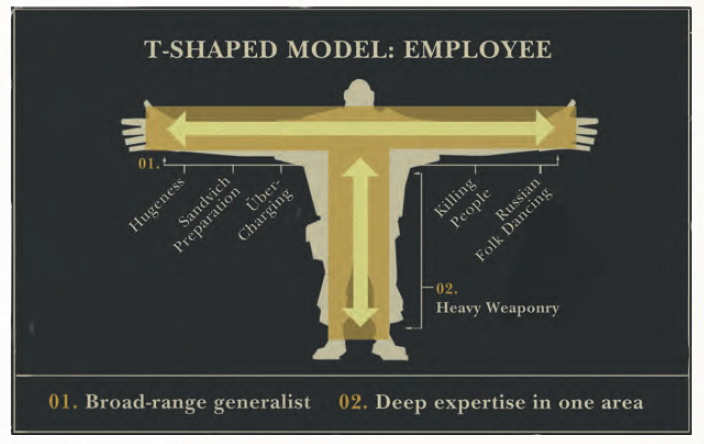
Joseph Greaser and I were discussing an article the other day. Over on the Game Development site, Gamasutra, Andreas Papathanasi wrote about Unleashing the Power of Small Teams. The whole article is worth the read because there are many gems. However I am going to focus on only one gem, The T-Shaped Person. Andreas talks about how he found this analogy in the Valve Handbook.

Valve looks to hire T-Shaped people for two reasons:

Valve's T-Shaped Employee, found in their handbook
Valve’s T-Shaped Employee, found in their handbook

1. A “T” has a deep knowledge and understanding in a skill area. Their knowledge here is so deep that they can contribute concrete ideas, solutions, deliverables within the skill area. You’re the best baker your friends have ever known? You’ve got the vertical part of a “T”.

2. A “T” has a broad range of knowledge across skill areas. They may not be masters of those areas, yet even some knowledge helps in communication, understanding of what’s possible, and often the eyes of a newbie can reveal the simplest solutions. This is the horizontal part of the “T”.

“T”s are especially useful on small teams or startups that are focused on delivering minimum viable prototypes. With their deep knowledge in one area, but broad knowledge of many areas, a “T” can construct testable prototypes easily. I may not have the development chops as some of my peers (I definitely do not), but I have enough knowledge to build prototypes that I can put in front of customers. You want to talk “minimally viable”? Have a “T” make you something from out on their horizontal branches.

Papathanasi went on to explain how the “T” exposes two other types of people. It shines light on people once thought to be “the best in the world”. We’ll call the first type “The Dash” because they consist of only the shallow horizontal part. We’ll call the second type an “I” because they have the deep skill and knowledge in one area, but don’t really understand anything outside of that. They prefer to stay within the wheelhouse. However I feel the “I” type can be broken down even further.

T is for Team
T is for Team

There are lower case “i”s that still have the deep knowledge, but sitting right on top of them is a dot. Dot = Period, Period = Stop. Holding them down is this dot that tells them to stop and go no further. Lower case “i”s have reached the point where the say “I’m good here. I can do this thing, and I’m happy with that.”

There are also capital “I”s that also have the strong vertical component, but they don’t have the dot sitting on top of them. No, they keep going up and up. These “I”s are looking to get better in their expertise area only. This can be extremely beneficial, but not on a small team. A small team needs everyone pitching in and doing jobs that they aren’t experts in to get the product shipped.

All of these types of people (“T”, “I”, “i”, and “the Dash”) have places on teams and can be extremely valuable to many organizations. Yet it is the “T” that is especially suited for a flat, small, innovative team.

Get a bunch of “T”s together and you get a platform you can build on ( TTTTT ), but if you put a bunch of “I”s together you will build a fence ( IIIII ).

So how can you become T-Shaped?

Let’s use the acronym FEEL because I had drafted my thoughts and was surprised that I could actually spell a word with the first letters. It worked out, so I’m going with it.

  • Fail – Yep! Fall flat on your face while trying something different. It’s ok. As Jake the Dog from Adventure Time says “Sucking at something is the first step towards being sorta good at something.” Remember when you learned to ride a bike? You undoubtedly fell then, and you will fall know. The trick is getting back on and broadening your T-Zone!
  • Experiment – Try stuff out. You’re not an expert so be cool with yourself just giving it a go. If you get some basic ideas down, try mixing and matching ideas. “What if I tried to make it do this?” Whether it falls apart or works flawlessly, you just leveled up in your T-Zone.
  • Explore – Wander into the unknown reaches of your work. If you know everything about your role, then you need to to explore into work-adjacent areas. Go beyond the edges of the map. You can either pick the brains of the other experts on your team OR you can see where your team’s skills overlap and leave gaps. This is fertile ground fro exploring because no one is currently in this region. Perhaps your prototype needs some video work done but nobody has video editing skills. Sounds like an opportunity to broaden your T-Zone.
  • Learn – Never stop learning. Your brain is like a muscle in that the more you give it something to workout with, it’s going to get stronger. You may not be an expert in your T-Zone… yet, but you could work up to it. Ask questions, read blogs, watch tutorial videos, you have a wealth of information at your fingertips. You found me, now I’m telling you to go find more!

Whether your small team is designing games or tea cozies, it will benefit from numerous T-Shaped people with different areas of expertise, but a culture of working outside the strengths to get prototypes validated. So fail spectacularly with your experiments in the unknown, because in those failures is where true learning lives.

Being Awesome, Like a Startup, Mastermind Games, Writing

Write Like a Startup

I’ve had this really amazing opportunity to freelance and do some game writing for indie studio, Mastermind GamesAffliction is set in small town America, circa 1950. You can smell the pies cooling on the windowsills, hear the brass band playing in town square, and everyone greets you with a smile. Until all that ended. You’ll experience the town as an abandoned wasteland, uncovering the tattered history, while keeping a safe distance from the shadowy Reapers. You can either cure the town or fall victim to the many dangers that lurk inside its borders.
Writing for the game has been an absolute blast and the more I write for this game, the more I’ve realized that game writing is like running a Startup. So I leaned into that slide and started to look at startups for ways to help my writing. Let me share with you four ideas I borrow from startups and how to apply them to your writing.
Bring Loads of Ideas
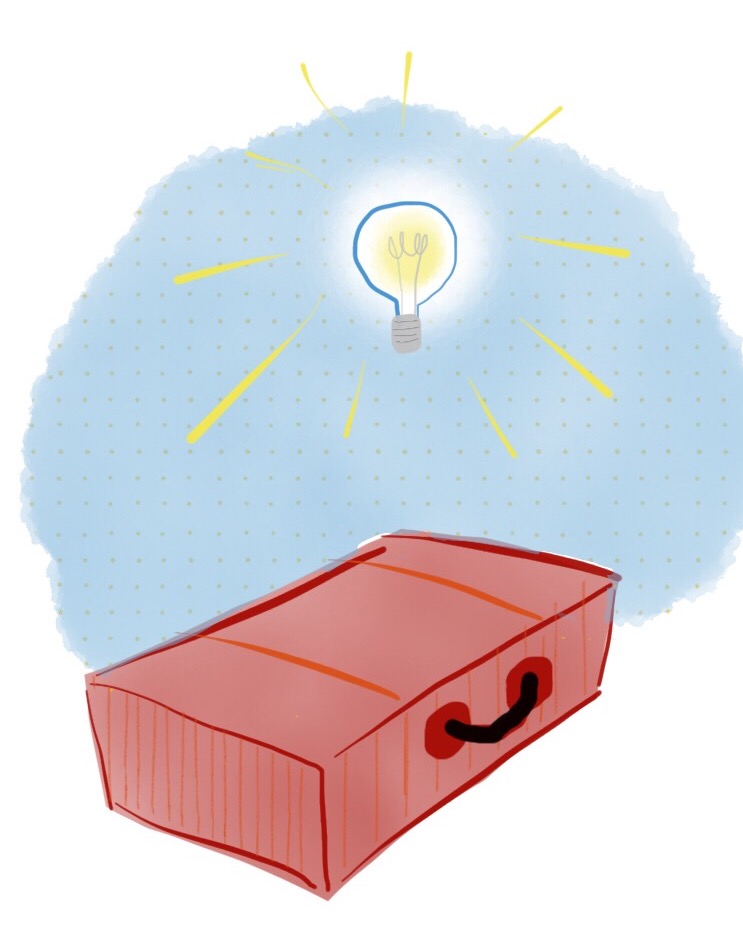
Picture a suitcase. A really large suitcase. In this suitcase you can fit every shirt you’ve ever owned. But wait! Before you start cramming your sixth grade Camp Okeechobee t-shirt into the suitcase, you’re going to fill it with ideas. And like a suitcase full of every shirt you’ve ever owned, only a few will get worn. Your “idea case” should be bursting at the seems because when you begin writing, you’ll never know when you’ll need to break out a new idea.
You can practice this skill by picking something you did today, and try to think of ten different ways you could have done it. Did you text a friend today? What are ten other ways you could have communicated? Once a list of ten is easy, try to get twenty, then thirty. The benefit to this method is that the first ten ideas you have are probably the same ten ideas everyone has. By pushing your limits, you will stretch and start finding more ideas, which leads to the more creative ideas.
Prototype Early and Often
You’ll envision the narrative in a perfect state, but until you get it on paper and in front of someone else, you’ll only stunt its potential. We’ve prototyped the narrative for this project a number of times. Each time we’ve been able to look at different aspects and really get a feel for what works and what doesn’t. Each prototype allowed us to get ideas out there, kind of play test them a little mentally, and identify which pieces worked.
If we hadn’t prototyped the narrative, I would be off happily writing myself into corners that the game wouldn’t able to fix. Worse yet, my literary lost causes, my poetic pinch points, my description the doglegs into a dead-end… they could all cost the developer money and time. No one wants to delay a game because their story got stuck and they need to circle back to when it made sense. The benefit has been keeping the narrative, in whatever raw and rough state it is in, out in the open for all of us to work on.
Be Willing to Kill Off the Bad Ideas
Admitting an idea is bad is not easy at first. But remember, we were chasing sheer quantity in tip Number One. Not all of those ideas are going to be winners. Honestly, they shouldn’t be. You can’t be afraid of taking the bad ideas, crumpling up the paper they’re written on, and sky-hooking them into the nearest trashcan.
Occasionally they aren’t even bad ideas! Sometimes they just don’t fit into the scheme of the narrative anymore. You will find yourself looking at that beautifully crafted story arc with its twists and player choices, and you’ll try to shoehorn it in. Unfortunately, like Cinderella’s step-sister’s foot and the glass slipper, it just won’t fit. Remember, it’s ok to kill off these ideas because if it doesn’t fit for you, it won’t work for the player/reader.
Pivot and Persevere
This is where all three of the previous tips blend together into a delicious stew. Since you prototyped your narrative (Number Three), you will be able to identify where the gaps are. These gaps either come from bad ideas where you need to prune those story branches (Number Two) or from missing steps between one chunk to the next, in which case you can try to bridge it with a new idea (Number One). However, here is where this practice gets its own number instead of being delegated a “summary”.
When you are evaluating your prototype, you will have to consciously make the decision “Should I pivot or persevere?”
Pivoting is when you’ve come to a dark spot that has failed so poorly that it just needs to be removed, replaced, and rewritten. Maybe you get to the end of a narrative road to find out that it is a dead-end and you really should have never gone down this road in the first place. Great news! Because you prototyped first, you found this before you wrote it in stone. It is way easier to swing a u-turn and pivot back to where the story is good.
The "ideacase"; chock full of ideas ranging from awesome to certified stinkers.
The “ideacase”; chock full of ideas ranging from awesome to certified stinkers.

You can persevere when your prototype road is good enough to move to deeper writing. Maybe it isn’t perfect, yet, but you can feel that it can get there. WARNING! This is not something you do because you just love this idea. It honestly has to feel right in the flow of your prototype and earn the ability to persevere. There is no room for “idea nepotism”; no narrative arc gets a free pass because its the nephew of the boss.

I’ve found by incorporating these Startup mentalities to my writing, I’ve destroyed some of the biggest barriers. I no longer fear the blank page; a.k.a. the Great Void. I am bringing an “idea case” full of good, and less-than-good ideas, to start shaping the page into my vision. I also don’t fear critiques either, because I know i’ve got more ideas and I’m willing to remove any of the ones that don’t work. So get out your notebooks, there are literary startups in your brain, waiting to hit the page running.
Challenge
  • The next time you sit down to write (your blog, a story, some game narrative, or copy for your product), fill your “idea case” with as many thoughts as you can.
  • Find a way to get your writing in the hands of some readers early. Even if it isn’t in a final stage. The roughness can sometimes help readers offer more honest critiques.
  • Protect your heart now that your favorite idea may not make the cut. 
  • When you do find a spot that isn’t working, dig in and see if you need to pivot, or if you can persevere and improve it.
Uncategorized

Uphill Both Ways… A New Appreciation

Stories have been a human tradition since the spoken word was first uttered. They are how we have shared experiences, traditions, and history long before any of them were put to paper. They have the ability to capture the minds and imagination of young and old alike and they hold the power to mold, shape, and share knowledge. Yet one type of story, passed on from generation to generation, has fallen on hard times.

“When I was your age we used to walk to school… uphill… both ways.”

Naturally our brain’s logic discredits the whole statement based on the phrase “uphill both ways”. We don’t even seem to care about the “I used to walk to school” part because “uphill both ways” is so illogical. A road can’t be uphill in both directions. Logic screams, “That phrase is wrong and, by association, your whole statement is wrong.”

Sorry logic, you’re wrong.

image

Let’s imagine a “stereotypical grandpa trying to be cool”. He is headed off to school so make sure you picture a backpack, sideways hat, a mismatched shirt and shorts combo, and definitely saying “I’ve got all my swag, yolo!” Oh “stereotypical grandpa trying to be cool”, you’re so funny!

Now imagine his school, on the opposite side of a hill. “Stereotypical grandpa” starts off heading uphill and then downhill before making it to school. On the way home he goes back up the hill and then down it again. I don’t mean to blow your mind here, but he went uphill in both directions. That means… shudder… grandparents have been getting that story right all these years.

“Aha!” you say, because you think you caught a mistake, and because “Aha!” is apparently a thing you say. “My grandparents never said anything about going downhill.” You’re right. No one ever tells the part about going downhill. Why?

Because going downhill is easy. Even inanimate objects can go downhill.

Now uphill, that’s the trick. Going uphill you get to duel with gravity face-to-face. Gravity is like a universal Goliath that affects even the largest of celestial bodies. Here you are, just a mere earthly David, spitting in gravity’s face. Each step up the slope signifies your defiance of gravity’s whims. When you reach the pinnacle of your ascent, you can stand with hands on hips and proclaim “Man has taken on gravity, and today, man won.”

Taking on a challenge, win or lose, is where good stories live.

Think about Mighty Casey and his baseball career playing for the Mudville Nine. As the story tells us, in the bottom of the ninth, he has an opportunity to win the game. He proceeds to take two called strikes first. Mighty Casey had a flair for the dramatic. He bashes his bat against home plate. He tightens ever muscle in his body as he stares into the sould of the trembling pitcher. Sawdust begins to swirl in the air because he is gripping the bat so tightly. The pitcher winds up, tosses the ball with his eyes closed in fear. Mighty Casey swings with the might of a thousand men…

Yet there would be no joy in Mudville, because Might Casey strikes out. Even though he loses, it is still a captivating story. We’re still drawn in because of the challenge of taking those two strikes first. Had Mighty Casey strode to the plate, swung at the first pitch, and hit a lazy flyball to centerfield for a routine third out, no one would tell his story.

Facing a challenge is the best thing we can do. It gives us a chance to grow, to be better, to learn more. No one got smarter by answering questions they already knew the answers to.

Challenges are where Awesome is forged.

At various points in our lives, we will stand at the base of a hill. Looking up, the top sure looks far away and the path can even look a little scary. However we must tackle that climb with willpower and confidence. It wont always be easy, but we’ll learn, adapt, and keep pushing.

No matter if we make it to the top or not, we will at least have a story to tell.

Challenge:
What uphill challenge are you facing? 

  • How will you know when you’ve made it to the top?

  • What are opportunities to learn / get better along the way?

  • Write an encouraging message to future you that will keep you climbing!

Being Awesome, Going Forth

Baby Godzillas

“Daikaiju” is a Japanese word that means “giant monster”. Daikaiju smash many cities, battle for Earth supremacy, and duel with giant robots from time to time. Daikaiju are forces of nature that are almost beyond control.

Sometimes innovative products get built like daikaiju. They achieve a grand scale before getting in the hands of the user. Yet innovation requires a delicate balance. You need to push towards disruption and you need to be able to get a functioning version into the wild.

Innovation’s delicate balance happens in a minefield of paradoxes. Think big, but test small. Build robust, but prototype fast. It is sometimes difficult to find a sweet spot because you could always be creating bigger / smaller.

No matter what medium you innovate in (technology, material goods, or pizza), it is too easy to push to the extremes.

  • Push your prototypes too far towards a final product and you risk missing some customer pain points.
  • Push your prototypes too small and your customer isn’t able to provide you any useful feedback.

And that is where baby Godzillas come in.

Yes, baby Godzillas. Not grown, adult Godzillas setting giant space slugs aflame in the middle of the Pacific. Definitely not just babies, with their drool and pudgy legs that look sturdy but are not strong enough to hold their own weight.

Baby + Godzilla = Sustaining + Disruptive

babyDaikaiju

Let me explain.

You may want your product to grow up and be the biggest and the best giant lizard there ever was. Yet you can’t wait for it grow up before you unleash it. It wont know how to swat down fighter planes from the fishing line that keep them in the air. You have to unleash it early and make innovative steps towards the grown Godzilla.

A big Godzilla is what your product can be. The big vision with the fully realized business model. A big Godzilla is your product emerging from the waves and striking fear into the Late Majority and the Laggards alike. It is a well-oiled product decked out in features (refined and sophisticated) with a mind set on success.

A baby Godzilla hasn’t completely developed all the features you intend it to. In fact, it may have more bugs than features, more questions than answers, more stinky diapers than flame breath. Yet a baby Godzilla toddling down the street is nothing to be laughed at either. It still causes a distinct reaction from those who encounter it. A baby Godzilla still functions, although in a potentially limited sense.

To some, a baby Godzilla is the best innovation they’ve ever seen.

The market is a delicate ecosystem. It takes prototyping, testing, pivoting, and persevering to get your product ready for success. If you develop a big Godzilla first, there are far too many unknowns and he could trip up before he ever sets foot in the city. Unleashing a baby Godzilla allows you to put something out there, see how everyone reacts, and then look at the potential to grow. Even though it will still have those awkward pre-teen years.

Baby Godzillas are:

  • Big enough to get the idea across (“I mean look at it, its clearly a Godzilla.”)
  • Big enough to have some functioning features (“He doesn’t have laser blast yet, but did you see him stomp that car?”)
  • Small enough to be sustainable for now (“We wouldn’t  have any room in the city for a much larger giant lizard.”)
  • Still innovative (“Yes I know it is just a baby Godzilla, but do you have one? No, didn’t think so.”)

Challenge:
Take a big, innovative idea and write down what the baby Godzilla version looks like: 

  • What features does it have?
  • How does it stand above and apart from the competition?
  • How it is minimally functional?
  • Doodle the baby Godzilla!